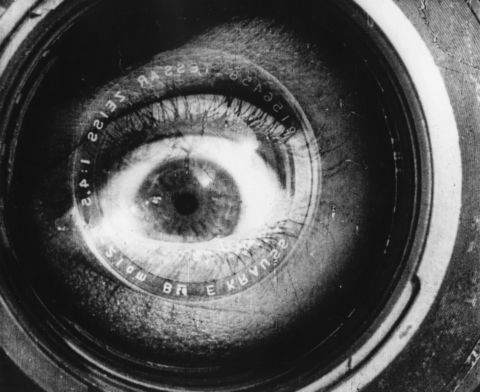
This is to be a film experience like no other, nothing theatrical, no actors or sets, not even a storyline, simply pure cinema. So how could you possibly start such a grand experiment? How about bringing the cans of the finished work to the cinema and having the projectionist reel them into the projector, as the empty auditorium below gradually fills up with interested members of the public who will make up the audience? Once everyone has arrived and the place is full, the lights dim and the film begins, appropriately with the beginning of a day in Moscow circa 1929, where some of the populace are waking up to greet the dawn, while others are able to sleep a little longer...
Dziga Vertov wasn't the director's real name, you know. He was born Denis Kaufman, but once he got into the Soviet Union's fledgling moving pictures industry he changed it to the Russian term for "spinning top", which he felt better described his wild personality and the flair he brought to his productions. Man with a Movie Camera, or Chelovek s kino-apparatom as it was originally called, was to be what many would regard as his masterpiece, even though the passage of time has made his frequent forays into Communist propaganda somewhat archaic, and it was present in this as well. You could reason that without those inclusions, his films would never have been made in the first place.
If you have ever seen the cult classic documentary Koyaanisqatsi then you'll have an idea of what was in store for the just over an hour of this, since that effort more or less adopted Vertov's whole approach and applied it to nineteen-eighties concerns. If you're thinking, "Well, what could a film created early in the twentieth century have to say to me now?" then you may be surprised as if anything it was bringing up universal experiences over and over again. But take a look at one shot in the first ten minutes: real people genuinely waking up in Moscow are shown, and one chap lying in the street opens his eyes to find the camera pointed at him, then laughs in amused embarrassment. We laugh too, and a connection across the centuries is made.
Vertov's brothers worked in the movie industry as well, as it was his sibling Mikhail who played the title role, already rather meta in that we see him going about his business as a cinematographer, but we are watching him through cinematography itself, which begged the question who was filming Mikhail? Was he filming himself? This could get unexpectedly mindbending if you allowed yourself to lose yourself in the barrage of imagery, with the director's editing restlessly skipping from one clip to another as if afraid of alighting on one aspect for too long lest he miss something out from the panorama of existence he was intent on capturing. This was documentary as experimental film, sometimes informative and other times imaginative, but diverting for all that.
All of human life was here, or at least all of it as far as Vertov could envisage, so not only was there a day in the life of twenties Moscow as a record of what made the people tick, but it was possible to gauge how much had changed and how much had stayed the same. That didn't wholly pertain to the Soviet capital, however, as the camera takes in workers in coal mines to sportsmen and women (Leni Reifenstahl was obviously taking notes at that bit for her Olympic Games documentaries) going about their endeavours, then the constants of any society such as birth, marriage and death. There was even divorce, and one woman at the courts hides her face in shame with her handbag as the camera rolls, thus denying her chance at immortality - nobody knows who you are now, lady. What most stands out is the emphasis on forward motion, acknowledging that time was passing even as you watched this, no matter when that was; it can be giddy with possibilities or saddened with regrets, Man with a Movie Camera was paradoxically contemplative as it rocketed along.
[The BFI have released a fine-looking Blu-ray of Man with a Movie Camera, considering its age and condition, which is packed with extras such as two other Vertov films and one short, an audio commentary and a booklet of essays.]