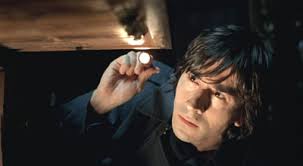
For decades it looked as if only faltering maestro Dario Argento was keeping the giallo alive. Then suddenly a new generation of young Italian filmmakers revived the genre. Horror fans wary after false starts like Al Festa's train-wreck Fatal Frames (1996) breathed a huge sigh of relief upon the arrival of Occhi di cristallo (Eyes of Crystal), a film that revives one's faith in Italian horror cinema. Opening in breakneck shaky-cam style as cop-on-the-edge Inspector Amaldi (Luigi Lo Cascio) and his world-weary partner, Frese (José Ángel Egido) pursue a violent rapist, the film then segues to the brutal murder of an amorous young couple and an elderly peeping tom in the country. Assigned to investigate, the intuitive but haunted Amaldi tries to decipher clues left behind by the killer who continues a string of grisly, dismembering murders. At the same time Amaldi comes to the aid of an attractive student named Giuditta (Lucía Jiménez) who fears a crazed stalker is dogging her every move. Meanwhile, Amaldi's terminally ill superior Ajaccio (Simón Andreu) is plagued with visions and suppressed memories hinting that the killer is someone from his past.
A taut, compelling, well crafted thriller, Eyes of Crystal keeps one foot in psychological realism and the other in gothic delirium yet somehow pulls it off. Adapted from a novel by Luca Di Fulvo, the film (which has script input from Italian horror veteran Franco Ferrini) has that typical off-kilter giallo plotting, reliant on flashbacks and premonitions. On the one hand it is pure Argento and yet unlike many of his movies the gritty, believable performances restrain things from growing too surreal. Luigi Lo Cascio is especially good as the haggard, haunted cop lamenting a love lost through violence and intent on wreaking revenge on criminals. However, both the writing team of Gabriele Blasi and director Eros Puglielli and the performances of co-stars Lucia Jiménez and José Ángel Egido deserve praise for adding dimensions beyond their stock roles of damsel in distress and jaded older cop.
Italian cinema has always looked to Hollywood for inspiration. Here Se7en (1995) appears to be a significant influence given the plot involves two detectives unpicking an elaborate murder plan wherein each decoratively staged victim is guilty of some particular sin. It is murder as performance art intended to convey particular message. Also our detective duo stumble around in the dark a lot yet no-one thinks to turn on a light. In addition, seasoned giallo fans will discern allusions to earlier classics such as the psycho's insane visions of a naked mutilated female victim that evoke the many dream sequences found in the gialli of Sergio Martino, e.g. All the Colours of the Dark (1972), or the possible nod to Argento's Phenomena (1985) when a buzzing fly alerts the bedridden Ajaccio to a vital clue. Even the presence of Simón Andreu alludes to the genre's illustrious past, given the veteran actor graced such lovably lurid favourites as Death Walks on High Heels (1971) and Death Walks At Midnight (1972), although he delivers such an empathetic and poignant performance his appearance proves more than merely an in-joke.
Slow-moving in parts but never less than compelling the film has some nice character details and a nifty visual sense when it comes to detailing how Amaldi pieces the mystery together. It is neither gratuitously violent nor especially sleazy in spite of occasional nudity and a climax with one victim trussed up in her underwear but drenched in atmosphere with impressively eerie and suspenseful set-pieces. Also the parallel plot with the dying Ajaccio adds an intriguing quasi-supernatural note along with a touch of pathos. Things get convoluted towards the end and the psychological reasoning behind the maniac's murder spree is spurious to say the least, but fans expect this from a giallo. Ultimately, Eros Puglielli assembles a stylish horror movie without getting hung up on style to the detriment of telling an intelligent, nuanced, often emotional story.