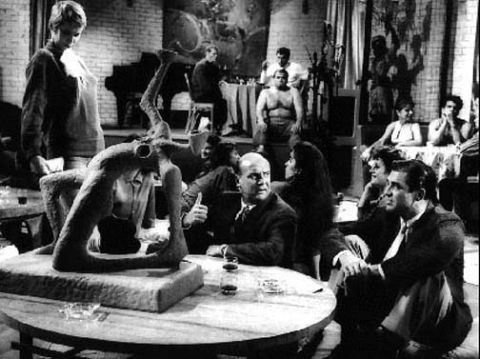
Stan Hess (Ray Danton) is busy reading up on his philosophy, for he likes to pose as a beatnik, one of that underground movement who regard non-conformism as the only real goal in this world of squares. But maybe Stan takes it too far: his girlfriend complains he never so much as holds hands with her as his beliefs appear to wrap him up in a nihilistic, what's the point? state of mind, which is understandable when his father shows up at one of his haunts to announce he is getting married yet again, to someone who could be young enough to be Stan's sister. He rejects his old man outright, and thus fuelled by hatred sets about his real kick: Stan is a serial rapist, he has a formula for his crimes and no one can stop him.
OK, there's one man who can stop him, for this was Ray Danton essaying one of his accustomed dodgy geezers which he was continually cast as until he was bitten by the directing bug and opted to stay largely behind the camera for the rest of his career. He assuredly wasn't playing the hero in this case, for producer Albert Zugsmith, a master of bringing sleaze to the big screen in the nineteen-fifties and sixties, appeared to have a grudge against the very folks his movie was made about. He had reportedly copyrighted the phrase The Beat Generation for use in this very production, which riled Jack Kerouac, the most celebrated of the beat writers, so you can imagine how he felt had he seen what Zugsmith had created.
The beats we see are a bunch of what would now be termed stoners, except we never see them take a puff of anything more than tobacco, though their zombie-like demeanour implies that it's something stronger than coffee they've been partaking of in those bars where Louis Armstrong (!) plays. Also playing is Cathy Crosby, who brings us a rendition of possibly the worst song ever written, but the beatniks are just as happy to listen to albums of car crashes, machinery and tuneless whistling because they have eschewed a going nowhere society (the shadow of the atomic bomb is referenced) to wallow in their own futile self-obsession. Just who did Zugsmith (and co-writer Richard Matheson) think would be going to watch a film with this title, anyway? Police officers?
Like the one played by the ostensible leading man Steve Cochran? He was Sergeant Dave Culloran, who has settled down with his second wife Francee (Fay Spain) and they're trying for a baby. As if Zugsmith thought the whole counterculture business wasn't enough to fill an entire plot, he offered many a lengthy distraction as Culloran is taught a lesson for his supposed woman-hating ways. Certainly he seems insensitive when questioning Stan's victims, just about blaming them for the attacks, although then we're presented with the character of Georgia (the inevitable Mamie Van Doren) who comes across as confirming that mindset since she invites Stan's stooge Art (James Mitchum, son of...) into her apartment and practically throws herself at him to spite her ex-husband.
As if that wasn't enough on one film's plate, Stan uses his ruse to wheedle his way into Culloran's home and rapes Francee, who finds out she's pregnant shortly after but doesn't know who the father is, leading us to a debate on the abortion issue which this being the fifties comes down on the side not of pro-choice but of anti-termination thanks to a brief discussion with an uncredited William Schallert as a priest (Francee isn't even Catholic). All of which is way too weighty to be supported by the silly lampooning that takes up the rest of the movie, especially that final half hour when there's the confrontation between Culloran and his symbolic misogyny Stan, involving the beatniks making up a song about going to the moon while Georgia is nearly raped for real and the cop is tied up and threatened with murder. One of those experiences where you have to occasionally pinch yourself to remind you someone thought it was a good idea, you also get Jackie Coogan in drag, Vampira reciting poetry with a rat, and Cochran subjected to sustained wrestling. Oh, and a human pyramid.