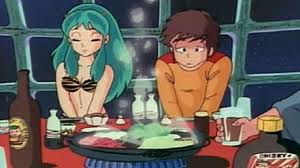
Some time ago planet Earth faced total annihilation at the hands of a powerful alien race called the Oni. Our world was spared as result of an intergalactic game of tag between gravity-defying, babelicious, tiger-skin bikini clad alien Princess Lum (voiced by Fumi Hirano) and Earth's unlikeliest saviour: Ataru Moroboshi (Toshio Furukawa), a lazy, self-serving, haplessly horny Japanese teenager who only volunteered because his opponent was the sexiest girl in the universe. However, Ataru got more than he bargained for. He not only saved the world but inadvertently bagged an alien fiancé. While every other guy at Tomobiki High School thinks Lum is the perfect dream girl, including Ataru's super-wealthy samurai boy rival Shutaro Mendo (Akira Kamiya), for Ataru's she is a literal pain prone to zapping him with super-powerful energy bolts in fits of jealous rage. Which happens a lot given Ataru not only has long-suffering human girlfriend, Shinobu (Saeko Shimazu) on the boil but can't help chasing every pretty girl he sees.
As if that were not trouble enough, Lum's presence proves a magnet for all sorts of intergalactic visitors, from floating space baby cousin Ten (Kazuko Sugiyama), bazooka wielding interstellar rocket-biker chick Benten (Yuko Mita), handsome ex-boyfriend Rei (Tessho Genda) who periodically morphs into a giant monster, oh-so-pretty-but-psychotic childhood gal pal-cum-soul sucking succubus Ran (You Inoue), pint-sized know-it-all Shintoist monk Cherry (Ichiro Nagai) and a whole host of other monsters, aliens and strange supernatural beings.
Published in manga form in 1978 and animated for television in 1981, Urusei Yatsura pioneered a genre that thereafter became a staple of anime: the science fiction screwball rom-com. It proved the first in a remarkable string of hit anime that became cultural touchstones and made writer and artist Rumiko Takahashi the richest woman in Japan. It was almost as popular among English speaking anime fans and exerted an unexpected cultural influence beyond animation circles. For this cartoon did indeed inspire a certain Glaswegian alternative rock band to adopt the same name. Only You was the first of what eventually proved six feature length Urusei Yatsura movies and marked the feature directorial debut of Mamoru Oshii. Oshii went on to be one of the most feted auteurs in Japanese film, both animated and live action. As part of the creative team known as "Headgear", alongside oft-overlooked screenwriter Kazunori Ito and chara designer Masami Yuuki, his anime films Patlabor 2 (1992) and Ghost in the Shell (1995) were praised by the likes of James Cameron and the Wachowski siblings, who cited the latter as a major influence on The Matrix (1999). Alas, in subsequent years both Oshii and his films grew increasingly quixotic and tedious culminating in the insufferable pretension of The Sky Crawlers (2008).
Here however there is nary a trace of the dour introspection and quasi-existential leanings that mark Oshii's later work. Although he went on to clash with Rumiko Takahashi over the "darker" tone of the second movie, Urusei Yatsura 2: Beautiful Dreamer (1984) - which many fans still rate the best of the feature film spin-offs - here the series creator remains the dominant authorial voice. Following the playfully avant-garde pre-title credit childhood flashback, Only You opens as a pint-sized alien mail man delivers letters inviting each of the vast supporting cast to the wedding of a certain Ataru Moroboshi. Only the bride-to-be is not lovely Lum but some other space princess no-one knows called Elle (Yoshiko Sakakibara). While Lum's smitten fan club of high school boys stand ready to lynch Ataru and Mendo assembles his private army to defend her honour, the spurned space princess demands answers. It turns out as a small boy Ataru accepted a marriage proposal from a strange little girl in the playground but quickly forgot about it when she left mysteriously and never came back. An enraged Lum promptly uses an enormous hi-tech vacuum cleaner (don't ask) to suck all their friends, family, a couple of stray cats and assorted eccentric bit-part players aboard her parents' enormous mothership as the entire Oni space fleet engage in galactic battle with Elle's all-female space fighters. Unfortunately the ever-horny Ataru escapes captivity for a shot at shagging a seemingly less high-maintenance alien sexpot. Elle turns out to be just as smitten and beautiful as our teen anti-hero had hoped. A life of luxury on her paradise world seemingly awaits until Ataru gets a nasty surprise...
Although part-influenced by American-made "magical girlfriend" sitcoms like Bewitched and I Dream of Jeannie, the core gag at the root of Urusei Yatsura's absurd universe is a high concept of Rumiko Takahashi's own devising. Essentially: sitcom problems inflated to galactic proportions, with the fate of the entire universe dependent upon the seemingly never-ending battle of wills between a fiery tempered space sex kitten determined to land her man and a horny idiot teenager. As concepts go it may not sound particularly profound but proved an exceptional source for all sorts of weird and wacky situations and oddball alien escapades sprung from Takahashi's remarkably fertile imagination. Along the way she also adroitly parodies an array of male archetypes, whether it is would-be ladies' man Ataru, the samurai stoicism of Mendo or the bury-my-head-in-a-newspaper-and-hope-my-problems-go-away attitude of Mr. Moroboshi, a delicious caricature of your typical Japanese salaryman circa the mid-Eighties. By contrast the female characters are uniformly brave, forthright, strong-willed and admirable, in spite of their fiery tempers. Heck, even deceptively demure Shinobu inexplicably summons superhuman strength when she gets mad. Takahashi was not the first manga/anime creator to reverse traditional Japanese gender roles but took the concept to new extremes.
That tradition endures in Only You which while notably slower-paced than the furiously frantic TV series proves no less inventive or hilarious when it comes to dizzyingly surreal slapstick action or endearingly silly puns. Particularly amusing is the moment the Oni fighter pilots, hitherto dying in their hundreds to defend Ataru, watch agape as the amoral teen betrays their cause for the chance to get laid. Some anime fans take issue with Ataru being such a selfish, shamelessly lecherous jerk but the character does have some redeeming qualities. He shares a tender moment with Lum here where he admits his true feelings. Plus it is worth noting than in a culture that places great value on the virtues of diligence, forbearance and self-sacrifice, much of the humour derives from Ataru's flagrantly selfish nature.
A bigger budget means flashier pyrotechnics in this feature length outing with some grandiose space battles lovingly hand-drawn by accomplished animators including nods to famous set-pieces from popular science fiction of the era: the arrival of the mothership from Close Encounters of the Third Kind (1977), space dogfights modelled on Battlestar Galactica (1979), Han Solo frozen in carbonite in The Empire Strikes Back (1980), the hero (in this instance heroine) racing to stop a wedding in space from Flash Gordon (1980) along with gag references to tent-pole anime like Superdimensional Fortress Macross (1982) and Captain Harlock (1978). With so much inspired lunacy onscreen Urusei Yatsura fans will not be disappointed while newcomers will likely find themselves charmed. Not least by the deliberately chaotic climax that not only spoofs The Graduate (1967) but interweaves the inevitable giant robot, a pitched battle between one thousand cryogenically frozen studs and an army of sex-starved Amazons, and a Godzilla cameo!
With Oshii's departure from the franchise following the acclaimed, aforementioned Beautiful Dreamer, Kazuo Yamazaki took the reigns for Urusei Yatsura 3: Remember My Love (1985) and Urusei Yatsura 4: Lum the Forever (1986). After a three year gap following the end of the television series versatile veteran animator Satoshi Dezaki delivered the deceptively conclusive Urusei Yatsura: The Final Chapter (1989) although it was Katsuhisa Yamada who delivered the real swansong with Urusei Yatsura: Always My Darling (1991). All are highly recommended. The Urusei Yatsura franchise is another gem emblematic of the golden age of Japanese animation when ambitious screenplays, character depth and visual experimentation were hallmarks of the genre.