There's an ogre (Amnon Meskin) abroad in the land, terrorising the country folk with his ability to turn into various fierce animals and gathering up a sizeable region to lord over. In that area there is Corin (Jason Connery) who has just seen his father pass away on his deathbed, surrounded by his three sons; Corin being the youngest doesn't get the mill they own, he doesn't even get the donkey, all he gets is his father's pet cat, Puss. It's better than nothing, and he does like the animal, it's just that he doesn't know how he'll get by with it for company, so when it races off in the opposite direction to the brother with the donkey who is setting out on his own, he is compelled to chase after it. Whereupon something unusual occurs...
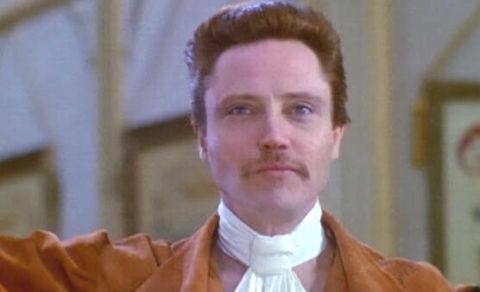
If you can call the cat turning into Christopher Walken unusual, that may have been an everyday occurence in the star's existence during the eighties, but what you had here was Cannon's attempt to cash in on the family market by adapting a string of fairy tales, which naturally they didn't need to buy the rights to since they were in the public domain as folk tales. That penny-pinching spread to the rest of the production as well, with the special effects the sort of thing that would shame a movie from the fifties, never mind thirty years later, and sets that were more functional than lavish, though at least the costumes had some time spent on them, if not a lot of money.
These Cannon "Movietales" as they were called didn't make a huge amount of profit at the time they were released, possibly because by this time their parent studio was spending cash like water with very little return on their investments, and they were not widely seen either, nowhere near the Disney empire's efforts that they so clearly emulated. But with some films, a lot of pop culture in fact, catch them at an early enough age and they will have you for life, and so it was with this series, with one of the cultiest Puss in Boots which was largely down to the casting. Well, let's face it, one example of casting in particular, and that wasn't Jason Connery, it was Christopher Walken, he surrounded by a bunch of non-celebrity Israeli actors and going at the role with some aplomb.
Not that he wasn't still extremely weird, for though they couldn't afford a proper cat costume for him, instead Walken acted catlike, or his idea of catlike anyway, switching from his cat form to human by use of the simplest camera tricks imaginable and often stroking his moustache as if it was whiskers, with an occasional ear scratch. Other than that, he acted exuberant as a magical feline should, demanding boots and a draw string bag from his dull master (Connery, essentially the straight man, could do nothing with so little to work with) which are the basis for building Corin an empire under the guise of The Marquis of Carabas, part improvisation on Puss's part and part a rather devious streak which sees him pulling the wool over the eyes of all and sundry.
The original storyline of the fairy tale was adhered to very closely - why mess with a classic, after all? - but there was a difference between reading a storybook in half an hour and spending an hour and a half with this leaden interpretation, with insipid songs that at least offered Walken the chance to do some of the dancing he was famed for but had so little opportunity to demonstrate in most of his other movies, though even then he only indulges in it about three times. Which meant the rest of the time we had to hear him sing, and whatever his skills as an actor his crooning was not exactly up to snuff, so the scenes where he, say, trilled a lullaby to Connery were more embarrassing than touching. The dancing from Walken aside, it was a heavy footed experience all round, in spite of a bright princess in Carmela Marner (daughter of the director - how did she get that job?), so what might have been more fun than this dutiful plod through the creaky yarn would have been a proper British-style pantomime. Walken would have been up for that on this evidence.