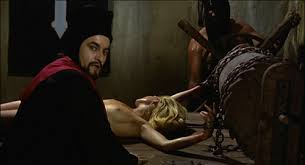
In 16th century France, religious zealot and magistrate Bernard de Fossey (Paul Naschy a.k.a. Jacinto Molina Alvarez) brings his team of inquisitors to the plague-ridden region of Perignac. Local beauty Catherine (Daniela Giordano) quickly catches his eye, tormenting him with impure thoughts, although her affections lie with her handsome fiancé Jean. Meanwhile, embittered one-eyed manservant Rénover (Antonio Iranzo) presents Bernard with his first group of torture victims when he accuses several sexy young things who spurned his advances of being witches responsible for the plague. One by one beautiful women are tortured on the rack then burned at the stake. No-one seems able to halt the Inquisition's reign of terror or the baseless accusations that cause so many innocent deaths. Until Jean dies in mysterious circumstances - glimpsed in flashback visions mimicking Once Upon a Time in the West (1968) complete with cod-Ennio Morricone riffs from Maximo Baratas' otherwise accomplished score - driving Catherine to ally herself with Satan (Paul Naschy again, in freaky goat-head makeup!) as his instrument of vengeance.
Spanish horror icon Paul Naschy was very much a self-made star. He wrote and sometimes produced his own movies right from the start with Frankenstein's Bloody Terror (1967). So it was inevitable that Naschy would eventually direct. Inquisition was his first effort as a triple-threat and arguably his most accomplished movie. Certainly Italian actress Daniela Giordano, best known for her sultry turn in Mario Bava's charming, Rashomon-inspired sex comedy Four Times That Night (1969), prized her role here as a personal favourite although Naschy himself favoured his ambitious but theologically muddled medieval satire El Caminante (1979). Although undoubtedly influenced by the witch hunt trend in Seventies horror cinema spawned by Michael Reeves' landmark Witchfinder General (1968) and bolstered by Ken Russell's non-genre though no less unsettling religious satire The Devils (1972), Inquisition also shares some disarming plot parallels with Jules Michelet's seventeenth century novel La Sorcière which was adapted into the outstanding avant-garde erotic horror anime Tragedy of Belladonna (1973). Naschy also studied transcripts of actual court cases dealing with the prosecution of so-called witches. This element of authenticity coupled with some impeccable production design enable Naschy to evoke a vivid sense of time and place.
Quite unlike his earlier garish comic book like Gothic horror romps, the tone here is measured, contemplative and pastoral save for the inclusion of exploitable elements like nudity and gore. There are the expected lingering scenes of sexy, sweaty naked girls strung out on the rack but with the exception of one, infamous nipple-ripping sequence, Inquisition does not succumb to the gore-drenched misogynistic excess of Mark of the Devil (1970) or its equally lurid sequel. Perhaps its most notable achievement is the masterful manner in which Naschy intertwines conflicting points of view on the events of the witch hunt: scientists and Satanists, bigots and true Christians, peasants and noblemen. Good and evil are shown to co-exist in every sphere of society. Naschy also delivers what is likely his finest performance as an actor. He boldly portrays Bernard as neither charlatan nor zealot but sincere in his desire to safeguard Christians from evil albeit severely misguided. Through the despicable Rénover, Naschy draws a clear link between the puritanism of the witch-hunters, misogyny and thwarted sexual desire as an array of good women are condemned to death for the crime of being beautiful.
Inevitably Bernard succumbs to visions of Catherine beckoning seductively in a red satin dress as she uses her allure to entice him into the inferno, climaxing in an act of mutual destruction. Scenes with the voluptuous naked Daniela Giordano writhing inside a chalk pentagram or cavorting with Naschy's goat-headed Satan could have sprung from the cover of a Seventies pulp horror novel. These fever dream sequences allow Naschy to let rip with some hallucinatory imagery and though the inclusion of a real Satanic presence dilutes his satirical attack on the excesses of the Catholic church he throws a few thought-provoking twists and surprises. Tragic, nihilistic yet undeniably powerful, Inquisition is a sober, intelligent historical drama with strong performances from both Naschy and his ensemble cast. In particular his most diverse and vividly realized range of heroines.