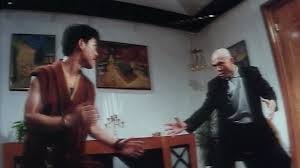
Hong Kong lawyer Robinson (Roy Chiao) arrives in Tibet hoping to strike a business deal with the Dalai Lama on behalf of his billionaire boss. He is greeted by ebullient monk Lo Ba Wong La (Yuen Biao) who quells his skepticism about Tibetan mysticism by magically healing his gammy leg. Impressed, Robinson summons his lovely assistant Chiu (Michelle Reis) to finalize the deal allowing the safe return of a priceless Tibetan treasure: the Babu Gold Bottle of Reincarnation. But back in Hong Kong, Robinson's boss is murdered by a whip-wielding lady assassin (Nina Li Chi) in league with the Sorcerer of Black Section (Yuen Wah), a powerful mystic hell-bent on stealing the gold bottle. Wong La's timely intervention saves Chiu from a trio of murderous assassins. Together they journey to Hong Kong, sparking a love-hate relationship as Wong La tries to adjust to city life and stop the Sorcerer from taking over the world.
As the youngest child performer of the legendary Peking Opera troop the Seven Little Fortunes, Yuen Biao carved his own distinct identity away from his more famous brethren Jackie Chan and Sammo Hung as the most gifted acrobat of his generation and a staple of fast-paced fantasy epics like Zu: Warriors from the Magic Mountain (1983), Mr. Vampire II (1986), Portrait of a Nymph (1988), Peacock King (1988) and Deadful Melody (1994). By 1992 Biao had appeared in so many of these films he evidently reckoned he could make a decent one himself. Hence, A Kid from Tibet, a pet project Biao nursed at parent studio Golden Harvest as his sole directorial effort. Filmed on location in Tibet (the end credits show cast and crew receiving a blessing from the Head Llama) the movie benefits from some spectacular scenery and architecture that impart a sense of spiritual grandeur to which Biao, as a devoted martial arts student, was no doubt sympathetic. Throughout the film, Wong La dazzles smug, seen-it-all city folks with his awesome telekinetic powers as he bends guns, zaps energy beams and levitates enemies. However, his powers go comically awry at a posh party where he inadvertently strips Robinson naked and threatens to do the same to Chiu to the delight of some dirty old men in the room.
Once the action hits the neon-lit streets of Hong Kong the plot engenders a severe case of deja-vu, coming across like a semi-remake of Clarence Fok's superior Yuen Biao vehicle Iceman Cometh (1989). This film shares the same fish-out-of-water jokes as country bumpkin Wong La proves comically clueless about city life, the same culture clash love story substituting former Miss Hong Kong Michelle Reis (acquitting herself well as an outspoken heroine) for Iceman Cometh's Maggie Cheung and even the same villain played by fellow former Little Fortune, Yuen Wah (“I want to rule the world of Esoteric Buddhism!”) As director Biao has a loose grip on the wayward plot but stages lively chase sequences and action scenes. One street market chase with Wong La trying to save Chiu from hired killers led by a gun-toting dwarf dressed like one of The Blues Brothers (did Yuen happen to see 9 Deaths of the Ninja (1984)?) bears a strong Raiders of the Lost Ark (1981) influence although the certain elements also recall Romancing the Stone (1984), Crocodile Dundee (1986), Highlander (1986) and even the Cannon Films version of King Solomon's Mines (1985).
For all its derivative aspects, the film does entertain. Most notably an uproarious sequence where Nina Li Chi (the future Mrs. Jet Li) attempts to seduce Wong La atop the bonnet of a sports car which turns into an energetic slapstick fu fight-cum-special effects set-piece as her supernatural powers go awry. Famed cinematographer Arthur Wong, who shot A Chinese Ghost Story II (1990) and several films for Jackie Chan, enlivens things with his trademark energetic camerawork and was likely responsible for the fancy in-camera optical tricks. There are some good gags such as the scene where Wong La repeatedly interrupts a pair of lovers courting in the park. Several critics have observed that the films of Jackie Chan and his fellow former child acrobats take an almost childlike attitude to relations between the sexes. Here, a smitten Wong La courts Chiu by playing pranks on her throughout the movie, continually exasperating the sexy city girl until she falls for his innocence and sincerity. Later on Wong La delivers a heartfelt monologue about his belief that people need to stay cheerful and optimistic about life even as he observes Hong Kong residents act like the world is about to end. It comes back to that omnipresent spectre in HK New Wave era filmmaking: the British colony's then-imminent handover to mainland China in 1997. The film also satirizes the region's me-first attitude when Chiu remarkably likens their situation to the Gulf War and asks “What's it got to do with me?”
Oddly the film does not get hero and villain into the same room until there is only twenty-five or so minutes left. Nevertheless the emotionally charged scene where Chiu endures torture yet urges Wong La not to reveal the magic words that activate the Gold Bottle proves worth the wait. The finale once again draws from Raiders of the Lost Ark as ancient cel animated spirits take on the bad guys. Overall, A Kid from Tibet is fun but formulaic.