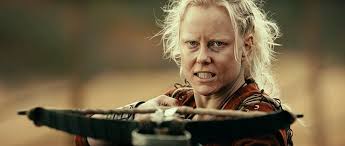
Norway, 1363: ten years after the Black Death ravaged the lands. A poor family making their way across a desolate mountain pass in search of a better place to live are attacked by merciless bandits. Only nineteen year old Signe (Isabel Christine Andreasen) survives the onslaught after seeing her parents slain and little brother shot dead by the bandit's leader, ferocious warrior woman Dagmar (Ingrid Bolsø Berdal). Unable to have children of her own, Dagmar takes the captive Signe back to the bandit camp plotting to mate her with husband Arvid (Tobias Santelmann) and sire a baby sister for her precious little daughter, Frigg (Milla Olin). However, Frigg does not share her mother's savage ways. In the dead of night she sets Signe free. Together they escape into the wilderness but are pursued by an enraged Dagmar and her warriors.
The spirit of Wes Craven hangs over this grimy, gory Medieval thriller – in particular his city folks versus savages masterpiece, The Hills Have Eyes (1977). As with that seminal Seventies horror the story here details the clash between two different value systems, civilization versus savagery as the peaceful village family are captured and bumped off one by one by barbaric killers. Eventually the lone survivor learns to fight back aided by a feral waif who still retains a spark of humanity. Norwegian filmmaker Roar Uthaug – and if you think his name is awesome, the costume designer is one Baron von Bulldog – first explored the idea of hostile landscapes harboring human predators in his slasher film Cold Prey (2006), although he also co-directed the charming children's fantasy Magic Silver (2009). Here, working with cinematographer John Christian Rosenlund, he paints a landscape that is vast, bleak and cruel as a backdrop for a story almost fairytale like in its simplicity. Early on Signe calls Dagmar a witch which proves telling as the plot boils down to two girls on the run from the wicked witch and her monsters.
Ensuring the pace never lets up, Uthaug serves up lean, taut thrills without an ounce of narrative fat though also without letting things lapse into a formulaic stalk and chase piece. Where the film carves a distinctive identity removed from something The Hills Have Eyes or The Texas Chain Saw Massacre (1973) has less to do with the Medieval setting than that the screenplay by Thomas Moldestad contrasts one strong woman with another along with their different approaches to survival. Whereas Dagmar repeatedly tries to teach Frigg that cruelty is strength and thus necessary if one wants to survive in the wilderness, Signe rekindles the goodness and compassion dormant in the wild child. The heartwarming bond that develops between Signe and Frigg counterbalances the sadism and violence that are otherwise relentless throughout the movie. It is worth pointing out however that neither Dagmar nor Arvid are drawn as one-dimensional monsters. Their love for Frigg is entirely genuine. For his part Arvid is not even sure bringing Frigg home is the best option. He only wants her to be happy.
The heroines eventually find an ally in a grizzled old bear hunter who clues Signe in to the tragic ordeal that made Dagmar the way she is and explains why she goes to such extreme lengths to hold onto her child. As Frigg shows she has learned a thing or two from her parents and repeatedly proves herself highly resourceful when it comes to surviving in the woods, it becomes clear she is the living embodiment of survival itself, for the future of Dagmar and her clan. As happens in the Wes Craven film the civilized victim proves clever enough to adapt to her brutal surroundings and fight back, improvising death-traps and other tricks. One area where Uthaug arguably slips slightly by comparison is in making little out of her loss of innocence although it remains immensely satisfying to watch Signe slowly morph into a kick-ass action heroine. Plus the pay-off is emotionally devastating.




 Display comments