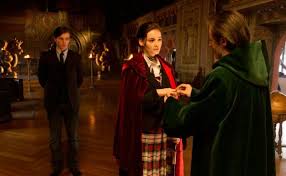
Sixteen year old Gwendolyn Shepherd (Maria Ehrich) is a German girl living at her grandmother's house in London with her mother Grace (Veronica Ferres) and kid brother Nick (Levin Henning). It becomes apparent to Gwendolyn that her family harbour some strange secrets. Most of the family regard Gwendolyn with contempt yet dote on her cousin, Charlotte (Laura Berlin) who suffers from a unique genetic defect that leaves her prone to fainting spells but possessed of a mysterious power. Charlotte has spent a lifetime training as part of a secret order for a special destiny. One day, out of the blue, Gwendolyn finds herself briefly catapulted back in time to the 19th century. It turns out she , not Charlotte, is “Ruby Red”, the one with the special gene enabling her to travel through time. Now she must take Charlotte's place, partnered reluctantly with handsome seasoned teenage time traveller Gideon de Villiers (Jannis Niewöhner) for a series of missions to uncover the biggest secret of their family's history, buried somewhere in the past.
Following the global success of Twilight (2008) and The Hunger Games (2012) Hollywood has not been alone in pursuing the lucrative teen fantasy market. Time and again the German film industry has proven they have the resources to produce blockbusters as slick as those made in the USA, e.g. We Are the Night (2010) or Vicky the Viking (2009). Having got in on the act early, cashing in on the Harry Potter phenomenon with gothic fairytale Krabat (2008), now Rubinrot (Ruby Red) marks Germany's attempt to launch an enduring fantasy franchise. Adapted, as is so often the case, from a bestselling trilogy of novels written by Kerstin Gier, the film gets off to an arresting start with a pacy period prologue involving two characters whose significance to the plot grows more apparent later on. Thereafter, despite the occasional lull caused by the filmmakers' tendency to verbalize rather than visualize Gier's admirably dense, complex plot, the story unfolds with an endearing amount of humour, intrigue and charm that lend it a distinct identity amidst the overcrowded teen fantasy film market.
It is no great surprise why films like these are so popular with young people. The thrust of almost all their plots is to enable insecure kids to realize those things that make them feel awkward and out of place will eventually serve as their greatest assets later on in life. Gwendolyn sees herself as a freak when in fact, as one character points out, she is “unique, precious and special.” Sure enough, feisty, outspoken Gwendolyn ends up questioning the order's ancient, implacable laws, challenging her crusty old tutors, thawing her initial frosty relationship with the dreamy Gideon and, naturally, transforms from plain Jane into an attractive, confident superheroine. On the one hand this plays to established teen fantasy tropes with ancient destinies, love triangles involving hot guys and sulky, sarcastic heroines with dark hair that might be put-upon outsiders but are special in ways no-one yet knows. Yet the film has fun exploring its central time-travel concept. Gwendolyn's second time jump enables her to meet her long deceased grandfather who reacts casually to her presence and becomes a mentor of sorts. Later on she bumps into future self only in the 18th century and ends up rescuing herself. Throughout the time-twisting story ancestors from the past entertain and do business with visitors from the future, which is a novel and amusing concept.
Like Harry Potter and The Hunger Games the heroine hones her powers in an environment that serves as an allegory for the high school experience placing adolescent angst within an epic conflict between good and evil. There is also a vague attempt to draw an allusion between her powers and the menstrual cycle involving a time machine powered by a drop of her blood. Some of the script's attempts at trendy teen speak come across a tad embarrassing though it is worth pointing out the English dubbed version imparts a cartoonish tone not evident in the performances of the German cast. Lead actress Maria Ehrich proves an especially strong and endearing presence as the plucky but insecure Gwendolyn. There is some welcome ambiguity about the plot as both Gwendolyn and Gideon ponder whether they are actually serving the cause of good or evil yet despite the odd exciting action set-piece the film knows enough about appealing to its target audience not to climax with an epic battle but with hero and heroine sharing a moment at the school dance. It ends with a lot of unanswered questions liable to frustrate some but leaves one eager to see part two: Saphirbleu (2014).




 Display comments