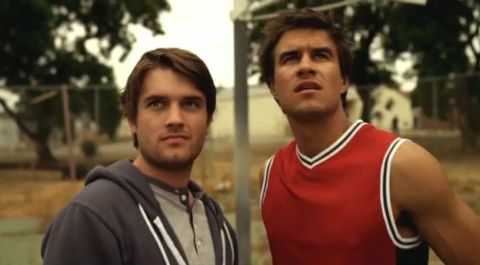
Dave (Chase Williamson) has a conundrum for you, but it may be embellished in the telling. Imagine you'd just beheaded a man with an axe, well, he was already dead though only because you had shot him, and he was a nasty neo-Nazi sort who you had to ensure really was dead and would not rise from the grave. Anyway, in the process of decapitating the body, the axe broke, so you went to a hardware store and bought a new handle for it. Then, later on, you broke the head of the axe when a creature slithered into your kitchen and had to have that replaced as well. So when the corpse did reanimate, was it right to assume this was the axe which beheaded him?
What that has to do with the rest of the plot was very possibly left on the pages of the internet instalments turned novel cult director Don Coscarelli had adapted for the movie version of John Dies at the End. That was penned by David Wong (aka Jason Pargin) and the consensus among its not inconsiderable number of fans was that it was better as a book - two books, actually - than it was as a film, but that was not to dismiss the levels of amusement generated by what wound up on the screen. It was certainly one of the nuttiest horror movies of its day, and a lot of that was down to how far it went in being none too clear about what was going on, as even by the ending you could leave lightly baffled by what you had just watched.
Although that great title seemed to be a massive spoiler, it wasn't really, it was simply more misdirection, which took up a good deal of the narrative as it alighted on one horror concept such as zombies for a few minutes, then would be off on another tangent such as a super-drug shortly afterwards. This brought in some cosmic, mindbending elements of the kind that may have been familiar from the more esoteric literature of the fantastical genres - your H.P. Lovecraft, your Philip K. Dick, your Robert Anton Wilson, your William S. Burroughs, and so on - yet was a road less travelled in the big screen entries, which made Coscarelli's efforts refreshingly offbeat, especially in his endeavours to keep things visually interesting.
This he did with a mixture of computer graphics and rubber effects, sometimes a mixture of the two, so a demon made of meat could have a little CGI decoration which rendered it all the more striking, though even so the budget was patently not huge. Nevertheless, this offered a more old school appearance to the end result many aficionados would respond to, and couple that with the offbeat quips and references and you had an engaging example of just how eccentric a horror flick could get if it was being guided by one filmmaker's vision: this really did look like the work Coscarelli had been determined to create. Part buddy movie - except the buddies are separated for long stretches of time - and part anything goes, gonzo shocker, almost a demented Scooby-Doo episode (Scoob could drive, right?), it constantly teetered on falling apart.
Yet somehow it held together, whether it was the director's firm hand or the cast deadpanning their way through frequently absurd lines, verging strongly on the slapdash yet the regular amusement it provided - assuming you shared its wacky sense of humour - was the source of a genuinely out there entertainment, one of the closest things on film to an actual hallucination without resorting to psychedelic clichés that might have had the enterprise looking like a lava lamp. As John (Rob Mayes) guides Dave (and us) through the increasingly bizarre landscape that taking a supernaturally-enhanced drug can concoct, along with arresting visuals were the occasional familiar face, such as Paul Giamatti (also a producer) as the journalist Dave is telling this tale to, with what starts as incredulity and builds to... more incredulity, Clancy Brown as a powerful preacher, and Phantasm favourite Angus Scrimm in one scene as a kindly, then not so kindly, priest. It might not have slotted together with a satisfying click, but you didn't really want that from it anyway. Music by Brian Tyler.