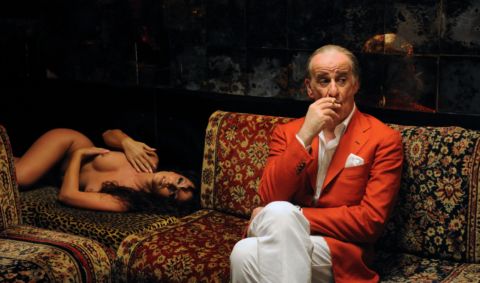
Jep Gambardella (Toni Servillo) is a journalist in Rome who as a young man wrote a novel that was so highly acclaimed that he never followed it up, not having anything more he could say that could top it. Still, the work did place him in the orbit of Italy's high society, and he relishes moving in the social world of the wealthy, all the while keeping a distance from it all the better to observe it with the clarity he wishes. In Rome there is a long history of cultural excellence, one which draws many tourists to the city, not all of whom can cope with the grandeur of the place, and the nightlife is second to none: Jep partakes of them both, so why is it that now he has turned sixty-five he feels so empty?
You may well feel pretty old by the end of near enough two-and-a-half hours of self-indulgence brought to you by Italian director Paolo Sorrentino in a film that won much acclaim and saw its creator having comparisons to Federico Fellini made. Except Fellini at least has a sense of humour and humanity which seemed to escape The Great Beauty, or La grande bellezza as it was originally known, and simply taking a peripatetic wander around various Roman landmarks, no matter how attractively they were presented - the cinematography was the finest aspect of the movie by far - did not mean you were going to get the same richly idiosyncratic view of life that the maestro did.
One of the problems here was that its central character was very difficult to get along with. He was supposed to be a wise old fellow moving from middle age to the territory of the elderly with a clear opinion of not only where his own existence fell down, but where everyone else he meets did as well, but far from a neat dose of reality to a landscape too often misguidedly superficial, Jep simply came across as smug and sanctimonious, hiding his cynicism and meanspirited qualities under that dreaded demeanour of telling it like it is, which more often than not meant insulting people and expecting to be thanked for it. Certainly there were plenty of audiences who thought there was insight here - the film garnered a brace of awards - but the acclaim was not universal.
With all this time to play with, Sorrento flitted like a butterfly, alighting from scene to scene, shot to shot, to better build up a bigger picture, not only of the Italian capital but perhaps of the entirety of life itself. Which would have been hard to consider from Fellini, never mind this pretender to that noble throne, although in effect it indicated there was a lot of it, but what there was wasn't necessarily as deep as intended. With no real story, just bits and pieces from the others Jep encounters, you found yourself trying to latch on to various aspects which might have you more empathetic towards both him and those who hoved into view, but what if the message Jep seemed to want to impart was that they had all been wasting their time?
That sense the days had passed on Planet Earth without much of any substance or progress or indeed meaning was not exclusive to The Great Beauty, but you did wish it had been better handled when for all its gilded illustration the film was more blowing a long raspberry at what we could only regard as a shallow lot filling their lives with ephemera. You could argue they were all so privileged with their profligacy and influence that they didn't deserve anything more than that, but this was a lengthy journey to go on for something any internet pessimist could have observed in a few sentences - words, even - and far more pithily (though possibly with more swearing). We are supposed to see the different hues of Jep's personality when he breaks down in tears occasionally, yet when he looks to be more crying for himself than those he has lost you can understand what a vertiginously high opinion he has of himself, his flaws being so much more interesting than anyone else's too. Throw in a few jabs at religion for spirituality and you had a chocolate box with nothing inside. Music by Lele Marchitelli.