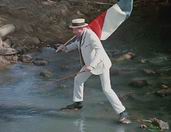
The First World War may be raging elsewhere, but for the people of the Ivory Coast life continues peacefully. The French and German colonials living there believe each party to be in charge, but are willing to live together in uneasy harmony as long as one doesn't bother the other. The French are made up of priests, shopkeepers, a prostitute and a sergeant, and they are happy to exploit the natives all in the name of a quiet existence, that is until the geographer, Hubert (Jacques Spiesser) who stays with them receives one of his rare parcels from home. It contains months-old newspapers which detail the war in Europe, and alerts them to the fact that they are at war with the Germans who live upriver. But what will they do about it?
Black and White in Color was scripted by the director, Jean-Jacques Annaud, with Georges Conchon, and put the ex-commercials director on the map, especially when his efforts won the Academy Award for best Foreign Language film. It takes an age-old theme, the futility of war, and applies it to the colonials in Africa, but these are no crack troops, ready and willing to take arms against their enemies and succeed through superior strategies, no, they are for the most part portrayed as buffoons whose misguided patriotism not only puts themselves in danger, but more pertinently, the lives of the natives who they selfishly recruit to do their fighting for them.
Assembling some soldiers from the men of the nearby village, the French hardly even bother to train them, instead deciding to strike while the iron is hot and rush off to the Germans' camp the following day and shoot them. The French treat the escapade as if it were an outing in the country, gathering up what little weapons they have and taking a picnic along too, until their peaceful meal is interrupted by the sight of their troops being slaughtered by the better organised and more military-minded Germans. They beat a hasty retreat, all willing to surrender, unless the beleaguered sergeant (Jean Carmet) can conjure up a plan to gain the upper hand.
Not only is the film an indictment of the attitude of taking over countries when your stronger presence is unnecessary, it sets itself up as a broad comedy as well. Some of it is quite funny, mostly at the expense of the cartoonish French: when the priests are being borne by the natives to get around, one remarks on how he loves the song the Africans are singing, just as the subtitles tell us they are actually singing about how the priests' feet stink and how fat they both are. Some of the humour can be quite sly, as an early scene sees the priests exchanging native idols with Christian ones, but too much of it is heavy handed.
The most interesting character is Hubert, who begins the film as a pacifistic, underachieving man of science, until he has a change of heart on realising what a shambles his fellow French are and he turns into a ruthless military man, organising the natives into war by playing on their prejudices, and leading to a stalemate with the Germans (complete with miserable, rain-soaked trenches) when he reaches their level of competence. Not only does this make the point about both sides being more or less alike in their attitudes - look who was organising the Germans - but unfortunately the comedy angle makes the Africans look like saps for agreeing to follow either side, despite the film makers' sincerity about the evils of imperialism. All in all, bumpy ride and rich with ironies. Music by Pierre Bachelet.