On this California beach one morning, a mysterious, scarfaced man named Barbado (LaSesne Hilton) walks onto a ridge and opens a package from which he takes a flute, then plays it as he observes the scene below. There is a coffin which has washed up on the shore, and a young hippy wandering along has his curiosity piqued so goes over to investigate, but as he moves to open the lid he is grabbed around the throat by Barbado and strangled to death. The hulking brute then transfers the casket from the sand to the back of his truck, and transports it to the nearest town where Pico (Bill Ewing) is having an existential crisis...
Pico is another member of the hippies, and there were quite a number of them to be seen in Deathmaster because this was one of those movies which was influenced by a sensational crime, which was the murders committed by the Manson Family. Before then if mainstream American society had a grudge against the hippies it was because their peace and love ethos was viewed as a dropout, left wing radical lifestyle, but after those victims died at the hands of Charles Manson's followers, on his orders, they were a focus of fear and suspicion, as if all they apparently stood for was a complete sham and they were an active threat to the nation.
Thus a few movies were created to cash in on this unease between the generations, which was curious since it was ver kids films like Deathmaster were aimed at, so what you had was a series of works which were torn between celebrating the groovy hippies and painting them as easily led by any self-styled guru - if said guru had a propensity for violence by proxy them so much the better. Nevertheless, for every I Drink Your Blood there were many more exploitation flicks which took their cue from the real life horrors of the Rolling Stones concert at Altamont as documented in Gimme Shelter, so if any renegade gang of young people were flounting society's rules in cinema they were far more likely to be Hell's Angels.
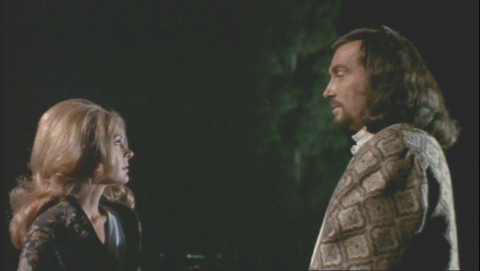
Which makes Deathmaster a curio, not least because it took a star who was emerging as the face of horror for the seventies, Robert Quarry, and placed him in this milieu where he was an actual vampire leading the flower children astray. There is a Hell's Angel in this, a chap called Monk (William Jordan), and he looks to be stirring up trouble (well, he offers an excuse for Pico to turn Billy Jack and unleash kung fu on his ass), but it was mostly the now-directionless young who the cult leader sought to dominate, in this case by biting their necks and draining their blood, thereby transforming them into the undead. Khorda, as the Quarry character styles himself, is full of bullshit quasi-mystical pronouncements which his new pupils fall for hook, line and sinker.
Except Monk, who is deeply suspicious when his girlfriend succumbs to Khorda's charms, and yer man Pico, whose lack of orientation in his journey through life makes him cynical, though not enough that he loses that essential innocence. Once his girlfriend Rona (future soap star Brenda Dickson, latterly a camp figure for her none more eighties "Welcome to My Home" video/ego trip) is lost to Khorda, who likes to see his followers dance for him in very 1972 throwing of shapes but doesn't appear to have thought out where he would go from there, Pico teams up with local shopkeeper Pop (John Fiedler, voice of Piglet in Disney's Winnie the Pooh adaptations). He is the only one he can persuade, with the cops naturally rejecting his claims and Monk forced out of the picture, but it all builds to a finale which represents something of a Pyrrhic victory - always check the contents of the coffin before plunging a stake into it, remember. This was so of its time that for modern viewers it would be difficult to get past the far out dialogue and fashion; for some it might be a bonus. Music by Bill Marx.