One summer a few short years ago, two young children were out on a lake with their father, when a waterskiing stunt went wrong as the speedboat smashed into their craft. Now, one of the children, Angela (Felissa Rose) is a young teenager being sent to summer camp with her cousin Ricky (Jonathan Tiersten), but she's a shy child who rarely speaks, not even to the overprotective Ricky. Once they get there, Angela won't say a word, and refuses to eat, so one of the counsellors sends her to the kitchen to meet the head chef to find something she does like. Unfortunately, the chef is a paedophile who attempts to molest the girl - luckily Ricky interrupts him and the two kids run out. Later on, the chef is apparently the victim of a terrible accident - could Angela or Ricky have something to do with it? Because it wasn't an accident at all...
Written by the director Robert Hiltzik, Sleepaway Camp arrived just too belatedly to be one of the more influential slasher movies of the late seventies-early eighties. Taking the summer camp set up familiar from the Friday the 13th series, it features younger kids than the usual twentysomethings pretending to be teenagers who you usually get in this genre, but the young adult counsellors there fit that bill. As is traditional, there is a mystery killer on the loose, who this time strikes every time Angela is victimised by someone at the camp, and we only have two suspects, making the murderer's identity a matter of either/or.
The heirarchy at the camp is a bullies' dream, with spiteful kids taking out their frustrations on their victims, and unintentionally leading to a backlash. Chief among the female perpetrators are counsellor Meg (Katherine Kamhi) and the younger Judy (Karen Fields), both highly overplayed examples of bitchiness who make Angela's life a misery. But it's not all bad, when Ricky's friend Paul (Christopher Collet) goes out of his way to make the introverted girl feel welcome - surprise! - she speaks to him. However, in this atmosphere there will be violence visited upon the characters, and while the bullies would appear to be closer in personality to murderers than their victims, it doesn't work out that way in these films.
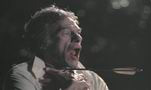
The killings are one notch below inventive, including a drowning, a nest of angry bees (which are invisible until after the casualty is dead) and that old Psycho standby, the stabbing in the shower. The best staged one is probably the briefest - an arrow through the neck - but the low budget of the film lends a seedy air to the proceedings that wouldn't be held in a glossier product. Being independent, the production comes up with plot ideas you wouldn't get from Hollywood, which is not necessarily a good thing, such as the ridiculous flashback vision Angela has which is only explained by the ending.
That ending is possibly the most celebrated thing about the film, a twist that throws new light on what has gone before, while still confirming expectations about who the killer was. For the most part Sleepaway Camp thrives on its illogical storyline - after the first murder occurs, wouldn't it be a good idea to close the camp and send everyone home? There's a killer on the loose! Despite the already worn out nature of the genre by this time, the last shot is worth waiting for in a "I can't believe I'm supposed to accept this!" kind of way, and it was successful enough on video for a couple of jokey straight to video sequels to be made, both of which this first effort is superior to. Music by Edward Bilous, and listen for the song over the credits.
[Anchor Bay have released a boxed set of the first three Sleepaway Camp films. The first has a cheerful, but not exactly informative, commentary, a trailer, notes and more. The sequels, which star Bruce Springsteen's sister Pamela, also have commentaries and trailers.]




 Display comments