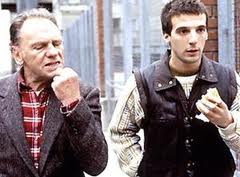
Hoping for a little excitement in an otherwise dull life, ageing businessman Simon Hirsch (Jean Yanne) accompanies his cop friend Mickey on a stakeout. He gets more than he bargained for when Mickey is shot and ends up in a coma. Months later, with the cops no closer to finding those responsible, Simon quits his job and all but abandons his family and embarks on a mission to catch these would-be killers. Meanwhile, in a parallel plot that takes place a few years earlier, crippled down-and-out Marx (Jean-Louis Trintignant) shares misadventures on the road with a simple-minded youth named Johnny (Matthieu Kassovitz), schooling him in the art of survival. Owing money to the mob, Marx and Johnny drift into criminal careers as thugs for hire and then eventually advance into professional hit-men...
See How They Fall (known in French as: Regarde les hommes tomber) marked the directorial debut of Jacques Audiard who went on to become one of France’s leading auteurs with such acclaimed, award-winning films as The Beat That My Heart Skipped (2005) and A Prophet (2009). The son of another respected filmmaker, Michel Audiard, the younger Audiard had form as co-writer of such notable thrillers as the Jean-Paul Belmondo vehicle Le Professional (1981) (although he disliked the film so much he had his name removed from the credits) and Claude Miller’s masterful Mortelle Randonée (1983), and helped pen comedienne Josianne Balasko’s directorial debut, Sac de noeuds (1985). But See How They Fall, based on a novel called “Triangle” by Teri White, really put Audiard on the map and established many of his reoccurring motifs: fragmented narratives, existential gloom, lost souls and social misfits leading comically hopeless lives.
Although aspects of the plot strand concerning Simon come across like a darkly comedic parody of the urban vigilante thriller (playing his use of electro-shock torture to interrogate underworld thugs for grisly laughs), things do not proceed down the expected path. Instead, Audiard weaves a strongly homoerotic subtext, contrasting parallel instances wherein young men unwittingly become a lifeline for older men mourning missed opportunities or wasted lives. The film is most unsettling when detailing Simon’s slow withdrawal from life and family, growing increasingly introverted and disenchanted. We never learn the exact reasons behind Simon’s mounting despair, although the film hints at his repressed homosexuality with possible sadomasochistic tendencies. In one scene he listens with growing fascination as an informant recounts how Mickey used to beat him. Later, Simon hires a male prostitute simply to hear him talk about what is like to be in a stable gay relationship.
However, it becomes increasingly apparent that what Simon seeks is an emotional connection rather than a sexual one. Which is exactly what Marx, his adversarial mirror image, comes to share with the pliable Johnny after numerous frantically funny attempts to mould him into an ice-cool assassin. Along with the time-twisted narrative, the film makes interesting, though on occasion disorientating use of a female narrator, chapter headings and even dream sequences. It is one of those films that could come across as gimmicky if not for the through-line provided by veteran French stars Jean Yanne and Jean-Louis Trintignant. Drawing upon their past history in film, the pair give exceptional, world-weary performances as what are almost the ghosts of the anti-heroes they once played throughout the Sixties and Seventies. Meanwhile, the film provided Matthieu Kassovitz with his breakout role and set him down the path that led him to major roles in both his native France and Hollywood as well as directing the seminal La Haine (1995). Kassovitz won a César Award (France’s equivalent of the Oscar) for his role as the ambiguously meek, childlike Johnny who comes across like a blank slate, willing to be moulded into anything his surrogate father figure wants him to be. Nevertheless while the conclusion is on one level undeniably perverse, it could also be interpreted as as a moving re-affirmation of humanity.