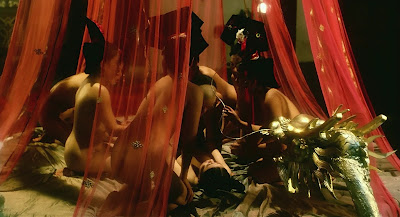
Our narrator is Li Liyang (Leung Si-Ho), a new eunuch at the Imperial palace in turn of the century China, who hides a secret. Thanks to his father’s friendship with the Royal Castrator, he still has one functioning testicle. An encounter with busty concubine Dong Qing (Chin Gwan) revives Liyang’s hitherto dormant libido and the pair begin a torrid affair. Meanwhile, sexually inexperienced young Emperor Tongzhi (Sung Boon-Chung) falls for cute chambermaid Guilian (Yvonne Yung Hung), enraging his mother the domineering and wicked Empress Dowager. Her right hand eunuch, the odious On Dahai (Stuart Ong) also has the hots for Guilian. He spreads a rumour Guilian is intent on becoming the next Empress, driving the Empress Dowager to sell her into sex slavery. At a local brothel run by kung fu hookers, nasty Hong Yi (Juliet Lee Wa-Yuet) and nice Eight Semi-Devils (Kingdom Yuen King-Tan), Guilian endures all kinds of hardship but eventually masters super secret sexual techniques that enable her to pleasure men without destroying her body. Meanwhile, Liyang and Prince Jing (Jimmy Wong Shu-Kei) accompany the Emperor as he searches for his lost love visiting every brothel in town and shagging a host of whores, which eventually proves his undoing.
The international success of Sex & Zen (1991) revived the historical sex romp in Hong Kong cinema, a genre that had lain dormant since the fengyue films of Shaw Brothers auteur Li Han-hsiang more than a decade ago. This new breed of bawdy Category III efforts were mostly produced the indefatigable Wong Jing, often tailored around the pulchritudinous talents of sultry starlets like Amy Yip and Chingamy Yau. With Sex and the Emperor Wong fashioned a vehicle for Yvonne Yung Hung, formerly Miss Asia 1989. She soon became a staple of glossy costume sexploitation fare, appearing in Ancient Chinese Whorehouse (1994), Chinese Torture Chamber Story (1994) and Lover of the Last Empress (1995). When the prestigious Yan Mei beauty club made a public stink about her involvement in such sordid films, she swiftly denounced her Category III past and went mainstream. She remains active today playing supporting roles in more respectable though lesser seen films.
In Sex and the Emperor Yvonne Yung Hung gives a surprisingly strong performance as the plot gradually darkens, shifting from good-natured sex farce towards grand guignol horror by way of two tragic love stories. While Dong Qing falls pregnant drawing the suspicion of the vile On Dahai, Tongzhi becomes locked in a battle of wills with the tyrannical Empress Dowager. The Empress Dowager remains a popular hate figure in Chinese history and with good reason given she drove the nation to the brink of collapse with her reckless spending and autocratic ways. Some revisionists claim she is unjustly maligned but the film plays to the myth. Typically for a Wong Jing production the tone is wildly inconsistent, shoehorning scatological humour, lurid torture scenes including a pregnant woman strapped to a water wheel and Guilian smeared with honey then covered with ants, jaw-dropping snippets of bad taste including real photos of genitals ravaged by venereal disease, riotous carnal-infused martial arts sequences including a hilarious display of naked kung fu calligraphy, and of course lots and lots of steamy sex.
Though ultimately less than the sum of its parts, in its better moments the film explores how sex was power at the imperial court. By controlling which concubine the young Emperor is able to sleep with, the Empress Dowager shrewdly manipulates the haplessly horny teenage ruler. In one memorable scene Tongzhi is forced to listen as her spies recount his amorous exploits in humiliating detail. Wong handed directing duties to long-time protégè (though no relation) Sherman Wong Jing-Wa, a specialist in innocuous comedies. Indeed his prior assignment was The Enigma of Love (1993) a rather more respectable rom-com pairing Jackie Cheung and Maggie Cheung, although he also directed the Amy Yip triad sex thriller Queen of the Underworld (1991). Aided by the superior cinematography of Tony Miu King-Fai and decent production values, Wong Jing-Wa’s direction proves adequate rather than inspired despite oft-outrageous set-pieces drawn likely less from history than the filmmakers' fevered imaginations. Yet while undeniably lurid, the drama is genuinely compelling, even affecting at times.