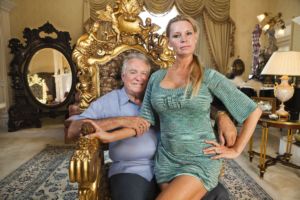
David Siegel is the owner of Westgate, the largest timeshare company in the world, and one of the United States' richest men. He claimed to be influential as well, and that he was instrumental in bringing George W. Bush to power as President, though he doesn't like to elaborate because he mutters something about what he did being maybe "not legal", but now, on his third wife Jacqueline who has borne him seven children, living in a huge mansion and building an even bigger one in Florida based on the French town of Versailles, and with a massive, blue glass skyscraper in Las Vegas as centre of his operations, it's all looking rosy...
And then 2008 happens, and things don't look quite so sunny. Documentary maker Lauren Greenfield took an unusual tack to her depiction of the world recession and banking crisis in that she chose not to concentrate on the people on the lowest rung of the financial ladder but a family who were at the top, and how the mixture of circumstance and bad judgement resulted their obscenely wealthy lifestyle slipping away from them. Although they were as much instigators of that crisis as they were victims, as Westgate basically made pots of money by selling to people who didn't have the funds to afford their product, and all with the blessing of the corrupt banks, this was not a film about schadenfreude.
Indeed, Greenfield was almost sympathetic towards the Siegels, especially Jacqueline who was the ex-beauty queen trophy wife finding her previously stable, pampered lifestyle evaporating as she was forced to sack all but four of her staff and see the pseudo-Versailles mansion threatened with foreclosure, and only half finished anyway because the money had run out. You could sense Greenfield rubbing her hands together as her story here became the perfect allegory for a country which had had more money than sense then having their chickens coming home to roost as all that cash simply dried up, but oddly the feeling was less angry (though Siegel isn't exactly a ray of sunshine at the best of times here) and more disappointed.
If that sounds mild, then watch for the people who relied on Westgate for their living, the call centre workers who were laid off en masse for example, or even the Siegel's army of nannies and domestics who are mostly immigrants working cheap - one woman longs to see her own children again but has to make do with the affection of her charges as Jacqueline likes having kids but also liked having someone else look after them, hence why there are so many of them. Even Siegel's eldest son who works for him cannot earn enough wages to get by, and speaks of the tense relationship they have, with business their sole common ground. The world of, as he describes it, people addicted to money like crack then forced to go cold turkey is a grim one.
And the fact that the banks were the ones making the profit out of this misery is an irony not lost on the film, especially as Siegel was one of those free market capitalists out to get as much as he could of other people's money on shaky foundations: you could say he was hoist to his own petard. After this was released he decided he didn't appreciate his portrayal and tried to force legal action on Greenfield; also he claimed the period depicted here where he was on the verge of losing everything was a state he recovered from, not to his previous levels of wealth but that he was doing far better than The Queen of Versailles would lead you to believe. To which you could just as easily say, tell that to all the unfortunates bankrupted, losing their homes and savings, and all down to the illegal practices which brought Siegel to the brink and that they toppled over. But you don't get angry watching this, it's more fearful and melancholy than that, though not without the prurience of seeing the bad taste of the super rich. Music by Jeff Beal.