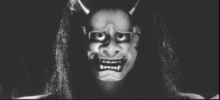
In 14th Century Japan, a feudal war is raging, leaving what peasants there are not involved at the periphery of society, barely getting by with what means they can gather. For the wife (Jitsuko Yoshimura) and mother (Nobuko Otowa) of one soldier recruited against his will, they do so by luring samurai into the long grasses surrounding their home as far as the eye can see and killing them, then stealing their armour and belongings which they can sell for food to a local merchant. But when a deserter, Hachi (Kei Satô) shows up with news, he proves divisive...
Kaneto Shindô had the distinction of being one of the oldest film directors of all time, completing his final film just a couple of years shy of one hundred years old, but going back in time to possibly his most celebrated work Onibaba, meaning Demon Woman, he was making a name for himself in his native Japan and tentatively around the world. If he never became as famous as some of his fellow countrymen filmmakers, then you just had to watch what he did with this horror story, how stark and striking it was both visually and thematically, and his talent was plain for all to see: this was one of the most unforgettable shockers ever made, as much to do with its strangeness as it was anything else.
With a plot which seemed to follow some ancient folk tale Onibaba may have appeared on the surface to be one of countless historical efforts which were all over Japan's cinemas around this era, here were some very modern concerns, mostly about the nature of sins and whether simple lust could be counted among them. For the wife and Hachi, they twig that the absent soldier probably isn't coming back, and they are desperate for the company of the opposite sex, not so much for romantic purposes but more to indulge in the pleasures of the flesh - anything to take away the pain of the drudgery and misery of their lives. But tell that to the mother, who sees her daughter-in-law taken away from her and fears for her own future.
No matter how much the older woman tries to sustain the way things were before, with the two relations carving out a criminal existence through their wretched but so far punishment-free activities, the presence of Hachi is going to mess that up, though quite how bad it would have got if she had not been so wild in her behaviour to put the young woman off her new beau doesn't measure up to how bad it really gets since she was. As Hachi and the wife throw themselves into a carnal oblivion, and there was a surprising amount of flesh on display to illustrate this as graphically as Shindô could for 1964, the mother schemes so when her needling words do nothing to change anyone's mind, actions are called for.
Of course, we can understand that for all the lust it entails, the wife is far better and more secure with Hachi, plus there's the benefit of not getting into murder, but the mother's senses have been warped by her fear and jealousy which makes one night when a lost samurai enters her hut all the more fortuitous - or so she believes. It's difficult to describe the sinister sensual nature of Onibaba without actually watching it, or indeed listening to it as the sound design was worthy of a David Lynch film: Hikaru Hayashi's harsh music, the grass and the wind concocting strange, eerie sounds as the wife runs through them to satisfy her desires. Then there's the visuals, a rich pallete of black and white which only adds to the menacing morality; by the time the lost samurai is telling the mother he cannot take off his mask as she lures him towards the pit in the ground where she dumps her bodies, we are feeling the dread of knowing this is not going to end well for anybody. And that finale is hard to shake - were they in Hell, as they suspected all along?