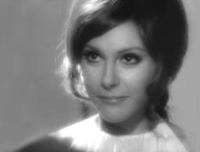
Marisa (Lucia Modugno) arrives in London with the promise of a job modelling there, so is picked up at the airport by one of the agency's staff in a Rolls Royce and swiftly transported to the studio where the photographer Bernie (Terence Skelton) is awaiting her. However, his bosses are less than accomodating to their latest recruit and demand she start shooting right away, not even allowing her to change in the dressing room and insisting she do so right in front of them. Understandably, Marisa begins to wonder what she had gotten involved with...
What she's actually gotten involved with was the first feature directed by British man of trash, Norman J. Warren, though this was tame stuff in comparison with what he would conjure up later on. It still had that oddly downbeat mood to much of his later work, but really did not distinguish itself as the work of a pioneer of pushing back the boundaries of what was acceptable on British cinema screens, if that's actually what Warren ever was. He had become a director of features after being hired by notorious producer Bachoo Sen, an expert in the field of sexploitation who was a significant player in that from the late sixties onwards.
Mainly his heyday, like Warren's, was the nineteen-seventies, which rendered Her Private Hell an interesting item of early efforts in that vein, though not all that interesting when you got down to it. Star Modugno, who resembled Lesley Ann Warren (no relation) facially, was a bright enough presence, but in spite of appearing in a few notable cult movies in small roles was never going to be a major player, and while she is fun to watch when her character starts dancing at impromptu moments (which is often), she could have been any imported starlet from the Continent given how much is required of her. Not even that "private hell" as stated in the title was much of a hell, or particularly private.
And Modugno didn't offer the impression of being up to portraying someone going through a terrible turmoil anyway, though she does get convincingly angry at times. However, she wasn't hired for her acting ability, but for her willingness to shed her clothes for the camera, which she does a few times but nothing tremendously explicitly. It appears Warren was keen to keep this classy, not something that would trouble him in the following years, so there's a respectful distance to the more revealing shots, which are often filmed in tasteful shadow: Peter Jessop's black and white cinematography is quite pleasing for a work of this meagre budget. Dramatically, on the other hand, it wasn't much cop.
Not exactly a riveting melodrama, then, and at this stage in movie history not much for the sex angle either, as it was all very tentative and hinged around Marisa getting taken advantage of as she is offered a place to live in a stately home (a flat which has a distractingly huge Roy Liechtenstein-style mural on one wall of a frame from a British war comic which you find yourself trying to read the captions on), supplied everything she needs, but has a notable lack of freedom otherwise. She falls in love with Bernie and his assistant Matt (Daniel Oliver), but as they both approach their roles in the same gruff manner you're not sure, as she isn't, which is the better bet. Matt takes a few snaps of her undressed which end up in a girly magazine, leaving her humiliated, which presumably is what passes for the private hell, although if anything it's a public hell. There's a sort of happy resolution to this, and a twist in the last line, but it's fairly unexciting otherwise. Music by John Scott.