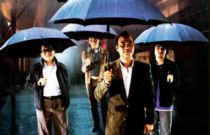
Sparrow is a slang word for pickpocket in Hong Kong, and smooth rogue Kei (Simon Yam) is just that. He leads a trio of light-fingered thieves, Bo (Gordon Lam), Sak (Law Wing-Cheong) and Mac (Kenneth Cheung Moon-Yuen) who prey on unwary tourists around the bustling city. Each man has a chance encounter with Chung Chun Lei (Kelly Lin), a beautiful yet mysterious young woman who outfoxes them but leaves them wholly smitten. Shortly thereafter however, each of the pickpockets has a hand smashed or leg broken by triad thugs. The man responsible is Fu Kim-Tong (Lo Hoi-Pang), an ageing, big time mob boss for whom Chun Lei is a kept woman. Enamoured with Chun Lei, and with their professional pride injured, the thieves decide to pool their talents and win her freedom.
Johnnie To made his directorial debut back in 1980 with the unjustly neglected martial arts adventure The Enigmatic Case. Over the years he’s had a varied yet consistently successful career in Hong Kong encompassing hit comedies, love stories, period kung fu films and even the odd superhero film, but only really found international acclaim with his run of gangster dramas, notably The Mission (1999) and Election (2005), which found particular favour in France. As a nod to his French admirers, To later cast gallic rock icon Johnny Hallyday in his crime thriller Vengeance (2009) which arrived on the heels of Sparrow, an elaborate love letter to the Nouvelle Vague whose influence upon the Hong Kong New Wave goes often overlooked by critics.
Shot in bits and pieces over a period of three years, the plot, drama and action in Sparrow unfolds in a series of stylised set-pieces choreographed like a Jacques Demy musical. Gliding steadicam tracks the thieves graceful, near-balletic movements. Lengthy, near-silent passages highlight the actors’ elegant use of gesture and nuance as storytelling (e.g. Kei and Chun Lei flirt by sharing a cigarette; the floating camera notes the contented glow on each of the pickpockets’ faces that reveals they’re in love) accompanied by Xavier Jamaux and Fred Avril’s enchantingly whimsical score, while To tips his hat to Jules et Jim (1962), early Jean-Luc Godard, the whole universe of Demy and outside influences like The Red Balloon (1956) and Jacques Tati in a splendid comic sequence where the characters cram into overcrowded elevator. Award-winning cinematographer Cheng Siu-Keung makes sublime cinematic use of real locations shot to look like studio sets, simultaneously real yet unreal.
Obviously, it’s all deeply romanticised with a “chivalry amongst thieves” ethos that has nothing to do with real criminals working the streets of Hong Kong. However, just as the Nouvelle Vague found more to empathise with among petty Parisian rogues than the haute bourgeoise, so too does To argue his lovable scoundrels embody the real spirit of old time Hong Kong. Kei and his brethren risk their lives for a romantic ideal, not for any possibility of actually consummating their passion for the enigmatic Chun Lei. As several critics have already noted, the romance is never really developed beyond surface infatuation. Some felt the film was too frothy by half. Given it was shot piecemeal, Sparrow does have the feel of an indulgence or at best a cinematic bon-bon for movie lovers. Sublime technique and splendid performances, particularly king of suave Simon Yam and the dextrous subtlety of Kelly Lin, give the film what weight it has. Also brevity works in its favour, with the last fifteen minutes or so devoted to a bravura, slow-motion pickpocketing duel involving a parade of umbrellas with raindrops ricocheting off them like bullets.