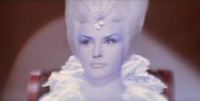
Here is Hans Christian Andersen (Valeri Nikitenko) and as he wanders the chilly streets of his hometown he has a story to tell us, only this time he includes himself in it for a change. He introduces us to the main players, the lead of which is Gerda (Elena Proklova), a little girl who lives a happy life with her brother Kay (Slawa Zjupa) and their grandmother who takes care of them. But one winter's night as they were home, there was a flurry of snow outside and a huge face peered in through the window: the Snow Queen (Natalya Klimova) had noticed Kay...
This was one of the vintage fairy tale movies from the Soviet Union, as for some reason making such things were immensely popular behind the Iron Curtain, and a fair few were leaked to the West as well. Some British viewers may recall watching this on television when they were little, and Americans could recall seeing it in cinemas in a dubbed version; for the Brits, it may not have the instant memories brought to mind that the classic of the genre, The Singing Ringing Tree, did but it was easily on a par with Three Wishes for Cinderella, Goldenhair or The Secret of Steel City which could be a source of nostalgia.
What most remember about these productions was often the frequent moments of true freakiness employed to bring their fantastical nature to life, and director Gennadi Kazansky, himself no stranger to this type of story, did not skimp on the weirdness even if it was a notch below some of the real oddity that others could work up. This stuck fairly close to the Andersen plot, but was actually more based on a popular play version of the classic tale, and of course Hans did not put himself in the plot as happens here. He doesn't dominate the proceedings, but he makes his mark and steps in to help Gerda at a crucial moment.
But what was most notable about this was that it appeared to be aimed at the female audience, for it showed the women to be far more resourceful than the males, who often came across as figures of fun otherwise. Once The Snow Queen sends her ice-white faced envoy to buy the only blooming roses in the winter, which happen to be owned by the grandmother, she is thwarted when no deal arises, so opts for something more precious: the life of Kay. She spirits him away behind her sleigh to her home in the North, and thus a battle of wills for the boy's soul erupts when Gerda proves herself the heroine when she heads off to bring him back, singing a song about her intentions as she went.
The characters she met were pretty bizarre, including at first a couple of very large crows who speak in a distinctive manner even in Russian (the male wears glasses too). It is they who point her in the direction of the castle where she meets the Princess, her betrothed (who Gerda was hoping was actually Kay, but he isn't), and the frankly bonkers King who plays mind games in an attempt to capture the girl. Later, the bandits make an appearance, with Gerda kidnapped by the robber girl (Era Ziganshina) who is the daughter of the bandit queen (more women in positions of power, as you see), and their rapport is charmingly off-kilter. When the special effects department let him down, Kazansky relied on animation to bring the trickier parts to life, but while that may disappoint those who are enjoying the brightly coloured and elaborate sets and costumes, it does offer the film yet more dreamlike imagery. Looking very strange to modern eyes, this version of The Snow Queen was a product of a bygone age, but worth preserving. Music by Nadezhda Simonyan.