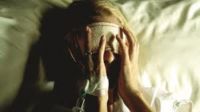
Sara (Belén Rueda) has recently had an operation to restore her sight, as both she and her twin sister Julia (also Rueda) suffer a degenerative condition which means their eyes are growing dimmer, and this can be exacerbated by stress. Sara is certainly suffering that tonight, as though she cannot see very well, she has a suspicion she is not alone in her house, and starts yelling at the man she believes has broken in. There is something there, a shape that is flashing light at the terrified woman, and once she ends up in the basement she's in real trouble...
That's because there's not only a noose hanging from the ceiling there, but there's someone who will make sure it is around Sara's neck and is quite willing to kick away the stool she's standing on, thereby killing her and making it appear to be a suicide. But is this a repesentation of what the half-crazed Sara thought was going on in her sightless state, or was there really a man there who did her in? Or even more creepily, could there be a supernatural angle here? These are the pressing questions which occupy us for the first two-thirds of Julia's Eyes, or Los ojos de Julia as it was known in Spain.
From a strong premise, you might be expecting an equally strong resolution, after all groping around in the dark could very easily turn into the stuff of nightmares, and indeed there is one bad dream sequence which throws the possible reality of the story into question. But even though you'll be sufficiently intrigued for at least an hour, director Guillem Morales simply led us up the garden path for that bit too long, so that by the end we had enough time to consider what we were watching and begin to think, wait a second, this is not a sensible horror story. Not that it needed to be, but the suspension of disbelief was somewhat shaky.
On the plus side, Rueda put in a sterling performance as the much victimised Julia, although as we find out there's really only one person doing that to her, the rest is all shadowy and obfuscated until the final act. In what could have been your all-too-basic woman in peril role, she manages to convince the viewer even as things are getting absurd that this is an ordinary person drawing on reserves of strength she never knew she had. It is Rueda who held the story together as Julia turns detective, convinced there was something deeply suspicious about her sister's demise, and not allowing anyone to divert her from the road to the truth.
Naturally, for this sort of movie, there was a repetitive quality as Morales had to find ways of speeding up the blindness process, so every fifteen minutes Julia got into a scary situation which reduced her eyesight by degrees, by which eventual stage she has to get a double eye transplant. This doesn't help immediately, because she has to wear bandages for the next two weeks, plenty of time for the sinister figure to close in on her, and we have a pretty good idea who it might be even if we don't entirely know his actual identity thanks to some clever camera business. Morales was courting comparisons to Alfred Hitchcock, maybe even Dario Argento as well, but what he truly owed a debt to was the Audrey Hepburn thriller Wait Until Dark which he adapted quite a bit of the suspense from. So Julia's Eyes was entertaining enough, but tended to unravel the further it went on. Music by Fernando Velázquez.