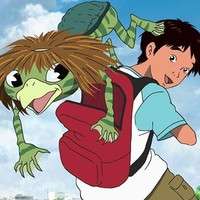
Kappa are river goblins from Japanese folklore. They have slippery green bodies, a birdlike beak, webbed hands and feet, a turtle shell on their back plus what can best be described as a Beatle haircut. Also every kappa has a plate on its head that must be doused regularly with fresh water lest they grow weak and die. Kappa have appeared in many live-action movies including the Daiei classic Yokai Monsters: Spook Warfare (1968), revisionist effects-fests Sakuya, Slayer of Demons (2000) and The Great Yokai War (2005), the heartwarming family film Kappa (1994) and the unlikely horror opus Death Kappa (2008). Although little known in the west, the most critically-lauded kappa movie to date is the award-winning anime Summer Days With Coo.
Beginning in Edo era Japan, a young kappa named Coo (voiced by Kazato Tomizawa) listens as his father (Kenichi Nagira) recounts how: “Dragons are scary, but these days humans are even scarier.” When the kappas happen across two wandering human officials, Coo’s father politely asks them to reconsider their plan to build on his swamp. Fearful the kappa knows too much, the corrupt samurai slash him to death, traumatising poor Coo. Whereupon a sudden earthquake swallows him up. Several centuries later, Koichi Uehara (Takahiro Yokokawa), a boy who is bullied at school and shares a fracturous relationship with an equally persecuted girl named Kikuchi, discovers the fossilized Coo who springs miraculously to life when doused with water. Koichi’s kindly Mom (Naomi Nishida) and Dad immediately identify him as a kappa, but his bratty little sister Hitomi (Tamaki Matsumoto) loathes the little guy after he accidentally spits in her face. Over the coming days, Coo grows closer to the Uehara family through his struggles to adapt to this strange new world. Koichi in turn learns social responsibility and overcomes his apathy towards the troubled Kikuchi. But when tabloid reporters leak Coo’s existence to the public, it becomes increasingly unlikely the kappa will ever find a quiet place amidst the human world.
Summer Days With Coo shares certain thematic similarities with the equally acclaimed Studio Ghibli anime Pom Poko (1994). Both films use mythological beings to weave potent allegories about the loss of traditional Japanese values in the wake of rapid modernization at the hands of seemingly heartless corporations. The characters, both human and supernatural, are social misfits learning to trust one another and the lyrical pace allows them to reawaken such neglected values as tolerance, courtesy, generosity and empathy. Equally, the film bears the influence of E.T. The Extraterrestrial (1982), being essentially about a lost alien being befriending a lonely little boy, sharing his suburban existence, bonding with the family dog, squabbling with his sister and at one point getting hilariously drunk. Several elements distinguish this as the kind of film Hollywood would never make. For one thing, Coo discovers Ossan the dog (Yoshito Yasuhara) has telepathic powers as well as his own backstory involving cruel treatment at the hands of a previous owner, besides his frustrated, paternal attempts to bring Koichi and Kikuchi together. Writer-director Keiichi Hara - whose feature debut was the theatrical spin-off from fan-favourite ESP-er Mami (1988) and remains best known for his hugely popular film and television series Crayon Chin-Chan (1992) - portrays his young characters in refreshingly unsentimental fashion. Much of the comedy involves Hitomi suffering for her bratty behaviour (wrestling enthusiast Coo judo flips her across the room!), though never cruelly so, while Koichi is initially apathetic towards the suffering Kikuchi.
By far the biggest difference between this and most family films, is its surprisingly bleak view of human nature. Although the Uehara clan embrace Coo as one of their own, the wider world proves far more capricious and cruel. When Coo becomes a nationwide sensation, reporters and gawkers camp outside his door, Mr. Uehara is pressured by his boss to make the kappa their company spokesperson, Koichi finds fame only fuels his bullies hatred (though his newfound judo moves put them in their place) and a talkshow appearance turns nasty when a folklore expert descended from the samurai who killed Coo’s father presents them with the severed arm. At this point the film morphs from E.T. to King Kong as a tearfully traumatised Coo escapes the enraged audience on Ossan’s back and scales Tokyo tower with tragic results for one close friend. Even more upsetting than this unexpected death is the sight of so many onlookers callously capturing Coo’s anguish on their camera-phones!
The film is handsomely crafted with poetic CGI flourishes melding with intricate hand drawn visuals, but flights of fancy take a backseat to its melancholy message. After a touching farewell to his human hosts, Coo seemingly finds hope of a peaceful live in a remote region of Okinawa where a friendly wood spirit offers to teach him the secret to adopting human form (“You can go to bars where young ladies are, heh, heh!”).