Haunted by nightmares and hallucinations, novelist Marie Adams (Romy Windsor) retreats to a cabin near a small country town called Drakho. The locals prove shifty and secretive while every night Marie hears a strange howling in the woods, which irks her husband Richard (Michael T. Weiss) since she proves in no mood for sex. Richard finds himself drawn to fierce-looking local art dealer Eleanor (Lamya Derval) while Marie strikes up a friendship with former nun Janice (Susanne Severeid). Her friend Sister Ruth (Megan Kruskal) went missing in these parts and has since been haunting Marie's dreams, warning of ravenous monsters. When a backpacking couple are found mauled to death, Janice suggests the town is plagued by werewolves.
After the camp excesses of the last two sequels, the Howling franchise fell into the hands of legendary exploitation producer Harry Alan Towers and director John Hough, whose eclectic C.V. includes at least two genuine horror classics: the sexy Hammer vampire movie Twins of Evil (1971) and the eerie A.I.P. production The Legend of Hell House (1973). Scripted by Clive Turner, who cameos as a tow-truck driver, Howling IV: The Original Nightmare tries to get serious again but still proves a witless, meandering bore. The much-maligned Howling II: Stirba - Werewolf Bitch (1985) and Howling III: The Marsupials (1987) may have been idiotic and inept, but at least they weren't dull.
Of the seven Howling movies, this one sticks closest to Gary Brandner's original novel, although the setup brings to mind the seminal Let's Scare Jessica to Death (1971), only with werewolves inhabiting a small town instead of the undead. Hough and Turner replay several motifs from The Howling (1980) that only remind us how ingenious Joe Dante and John Sayles were in the first place. These include the adulterous husband trysting with a feral nymphomaniac in a sweaty but repulsive sex scene wherein talentless Lamya Derval (styled like a refugee from Dynasty) gurgles like she is about to throw up rather than enter the throes of passion.
Early into the film a concerned doctor remarks that Marie "... needs to go somewhere where her imagination won't be stimulated", which as in the equally risible Cellar Dweller (1988) implies creative minds are more prone to madness. However, core theme of Marie's troubled psyche fails to grip since the characters and their relationships are too poorly detailed for us to care. What's more, we never learn why Marie was having a nervous breakdown to begin with. Soft-spoken Romy Windsor pouts earnestly while soap regular Michael T. Weiss flounces ineffectually about the place, letting his bouffant hair, designer stubble and exposed chest hair do all the acting, as he fails to register a single human emotion beyond abject boredom. To be honest, you can't blame him since the plot is repetitive and illogical. The small town milieu feels inauthentic, with actors straining hard seem quirky and menacing and hang onto their flimsy Southern accents. Cheesy synths signpost all the would-be scary "is-it-a-dream-or-not?" scenes where Marie runs through misty woods, but Hough injects not one iota of suspense.
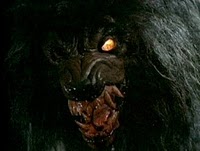
After eighty-four stupefyingly dull minutes, the film crams all its meagre thrills into the last ten. One character melts into a putrid mess then reforms as a werewolf and another rips off human skin to reveal slavering lupine jaws. The briefly glimpsed lycanthropes are relatively nightmarish Steve Johnson creations, but by now viewers are clutching at straws. Eventually a minor character sacrifices their life to destroy the werewolves in a burning bell tower, but Marie stupidly hangs around for one last minute "gotcha!" There, I have just saved you ninety-four minutes of your life.




 Display comments