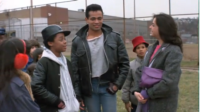
John Hood (Mario Van Peebles) has just been released from a spell in prison and when he returns home it's as if he's never been away, with his friends greeting him warmly and his family very pleased to see him and learn that he's planning to turn over a new leaf. Now he wants to make rap his career, as does his younger brother Allan (Leo O'Brien), but their Grandma (Edye Byrne) tells him that he cannot go out with John because he's not old enough. To compensate the two brothers perform a rap together about how great they are, but there are those who would disagree...
And not only those watching this movie, either. After Cannon had hits with the Breakin' films, they were on the lookout for another cash in, and as breakdancing had that hip-hop glamour, what better choice for a follow up than rap? There had been some of it in movies before, and a small few of those built stories around it, but this was truly going the Rock Around the Clock route by latching onto the hip new style and hoping to make a lot of money from ver kids who would watch anything that had the appeal of cool, whether it really did or not. This, needless to say, did not, and so many people saw through Cannon's cynicism that it went on to suffer a terrible reputation.
Meaning that for bad movie fans, Rappin' was ideal, with so much to make fun of it was a positive feast for amateur critics of all stripes. With rhymes that made Morris Minor and the Majors sound like Public Enemy, the fact that Van Peebles was actually using lyrics thought up by none other than Ice-T (who had small roles in both Breakin' movies) was only slightly less embarrassing than the rap legend's appearance on Mr & Mrs, especially given numbers like Snack Attack which detailed the portly member of Hood's gang's love of food. That none of these words even flowed properly was testament to the production's "Will this do?" attitude to moviemaking rather than any laziness.
You could argue that this was simply an 8 Mile for the eighties only without the success, and the power of rap to improve the performers' status in life was part of the civic mindedness on display. The main plot was concerned with that ancient plotline, the evil developer (Harry Goz) who wanted to knock down the hero's neighbourhood to build some swanky new apartments on, so what can Hood do but live up to his name? "Huh?" you might think, "How does that work?" but the screenwriter obviously hit upon a clever thought: "Rappin'" sounds a bit like "Robin" (erm) so put "Hood" on the end of that and you have a modern day Robin Hood for the mean streets of Pittsburgh.
This meant you were offered two - count 'em - scenes of Hood stealing from the rich to give to the poor to justify such a conceit, but most of the rest of it bothered itself with filling up that all-important soundtrack album, with even non-rap tunes included. Ice-T did actually show up at an audition that Hood enters, and he is representing the harder edge, which we can tell because he's holding a machine gun on stage, far more butch than the scene in the nightclub which sees a dance off between two minor characters that goes quite some way to making the audience cringe even more than Mario rapping with a bunch of small children. The love interest was future prolific cartoon and video game voice artist Tasia Valenza, playing Dixie who is now the girlfriend of baddie Duane (Charles Grant), the man who the developers hire to intimidate the locals, but judging by the musical ending where everyone in the cast joins together, there's nothing rap cannot solve. Except the credibility crisis of movies like this.
Israeli theatre director who broke into Hollywood movies after twenty years of directing in his home country with breakdance movie Breakin'. He followed it up with inoffensive low-budget exploitation fare like Rappin' and Lambada.