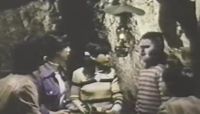
Schoolchildren Caroline (Hiroko Saito) and Johnny (Masaaki Kaji) are visiting their chirpy scientist friend, Catherine (Reiko Tokunaga) at a cryogenic research centre when a sudden earthquake traps them inside three freezing pods. They emerge from cryo-sleep into a post-apocalyptic earth overrun by super-intelligent apes and are pursued by human-hating Police Chief Gaybor (Baku Hatakeyama). Except the English dub, produced by Sandy Frank, the man who brought Battle of the Planets (1972) a.k.a. Science Ninja Team Gatchaman to the western world, insists on pronouncing his name as “Gay Bar”! As a result, Time of the Apes prompted scores of sarcastic young viewers to run around the playground cracking jokes like: “I want to take you to Gay Bar!” or “There is no escape from Gay Bar!” Trust me, when you’re ten years old, it’s hilarious. On the other hand, when you’re twenty-something, it’s puerile and frankly homophobic, so let’s move on…
On the run from Gay Bar (stop it!) and his ape patrol, the young fugitives befriend Godo (Tetsuya Ushio), a karate kicking action hero who has been surviving in the woods aided by a friendly little ape girl called Pepe (Kazue Takita). Our heroes embark on a perilous journey to see if there are any other human beings about on this strange, ahem, planet of the apes, but are trailed every step of the way by an ominous looking U.F.O…
Time of the Apes was cobbled together from episodes of the Japanese television show “Ape Corps”, something clearly evident from its frantic, often nonsensical story structure. Produced by Tsuburaya Enterprises, the outfit founded by Eiji Tsuburaya, special effects director on Godzilla (1954) and creator of Ultraman (1967), the show was one of many Japanese genre outings of the time to feature speaking simian characters. Evil apes from outer space plotted humanity’s doom in Spectreman (1971) and Godzilla vs. the Bionic Monster (1974), while a more benevolent, cigar chomping space orangutan was among the heroes of Swords of the Space Ark (1979), but Ape Corps was by far the most blatant imitation of the classic Planet of the Apes (1968).
The Japanese effort features a greater variety of primate makeup than the Hollywood hit, almost as good as John Chambers groundbreaking work (although the apes’ mouths don’t move as well). Missing is the carefully constructed social strata of ape civilisation along with the allegorical overtones of Pierre Boulle’s novel. It’s a sub-Irwin Allen adventure yarn with monkeys. This being a Tsuburaya production the miniature effects are superbly detailed and the opticals are done with surreal flair. Nifty editing and offbeat angles add some much needed pace. On a purely pulp level there is some fun to be had, nonetheless it is easy to see why this bogus feature gained some notoriety as a “bad film classic.”
Leaving aside the absurd Anglicization of the Japanese characters, characterisation is paper thin (Caroline and Johnny) or bizarrely inconsistent (the pimp-suited ape leader, His Excellency who goes from slapping the heroes silly to benevolent voice of reason), while the plot mechanics display an alarming lack of logic. Ruthless editing renders several subplots incomprehensible, including the renegade ape politician plotting a coup against His Excellency because he is supposedly soft on humans. Beneath the kiddie matinee sci-fi stuff resides an underlining bleakness. Catherine is a hopelessly indecisive pacifist-liberal and Godo a two-fisted obstinate whose actions prove wholly ineffectual. By the movie’s end these dimwits reject His Excellency’s offer to live in peace among the apes and take their chances with the UFO, which precipitates the last fifteen minutes of trippy, traumatic and frankly incomprehensible plot twists.