When police notice a car pulled up in front of this smalltown bank, they go to send them on their way, but on inquiring, they discover an old man and his daughter bickering about cashing a cheque and allow him to go inside as long as he doesn't take too much time. But as they drive away, they register something suspicious about the number plates and call back to the station for confirmation that the vehicle is not on the level. On returning to the bank, they find a robbery taking place, with one of the guards and one of the gang dead...
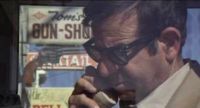
Not to mention the cop who asked the woman for her driving license and got a bullet in the head for his trouble, although his partner gets off a shot as she drives away with both the loot and the two surviving robbers. It's an explosive beginning, and one which serves director Don Siegel well as we remember the brutality and callousness of that opening sequence through the rest of a more subdued movie, perfectly aware than the title character is not someone to be trifled with. That character was played by Walter Matthau, who was the old man we see at the start, and he has disguised himself for the crime, although the fact remained Matthau was pretty unmistakable no matter what kind of makeup he was wearing.
Nevertheless, we can tell that while Charley is a small time crook, he has the business worked out to the precision of a Swiss watch, which not coincidentally was how Siegel had worked out the twists and turns of his film, helped by an excellent script from Howard Rodman and Dean Reisner, both of whom knew how to play to the strengths of both the director and the stars. Oddly enough, though, Matthau did not like this semi-classic all that much, in spite of putting in one of his very best dramatic performances, as he claimed he didn't understand what was going on - not that you'd notice from the way Charley carries himself as he realises the three quarters of a million dollars he has lifted belong to the Mafia.
He may have it all worked out in his mind as to how he and lone surviving accomplice Harman (Andrew Robinson, who had made his name as the villain in Siegel's Dirty Harry) can now get away with the loot - waiting three or four years before they spend it might help - but the bad guys, or even worse guys, technically, are on their trail and set a hitman called Molly after them. In one of his finest roles, Joe Don Baker plays that character with deceptive good old boy charm that quickly turns to menace, getting some of the most memorable lines in the picture to boot ("I didn't drive six hundred miles for the amusement of morons," is one). He's one of the most formidable and implacable foes in Hollywood thrillers.
Which makes it all the more unlikely that Charley will be able to lie low with his cropdusting company when Molly, and it seems just about everyone else he contacts, is in on the Mafia's circle of influence. One of the pleasures of this movie is not only in that ingenious plotting, but in the way that every significant part is cast with some seasoned character actor or actress, so you get John Vernon as the Mob's banker who does his own investigating and gets in over his head, to the likes of Sheree North as the photographer who double crosses Charley, all played with that snap and cynicism that made the most accomplished of this decade's thrillers so satisfying. If anything, this is too coldblooded for its own good, and you can see why the hardbitten style can turn people off, as nobody in this is friendly - tolerant to a point, but they've seen too much of the dark side of life to be compassionate. Only Charley gets the odd moment of tenderness, and that's why we support him in this sunbleached, harsh and criminal environment. Music by Lalo Schifrin.