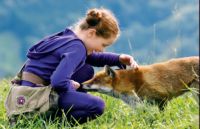
She remembers the year she spent as a ten-year-old girl (Bertille Noël-Bruneau) in and around the countryside her parents lived in, and how she loved to abandon her cottage home for the day to investigate the flora and fauna surrounding her. But there was one animal above all that made an impression on her which would last for years, and that was the fox she caught sight of one day when she was out in the forest as Autumn began to settle. The girl became obsessed with watching the creature, and wished to go further and be part of its life...
Writer and director Luc Jacquet hit the jackpot with his internationally popular, if incredibly twee, documentary March of the Penguins, winning an Oscar for his trouble, but when he chose to follow it up he opted for a tale closer to home than a different continent in the world's least hospitable landscape. According to him, The Fox and the Child, or Le Renard et l'enfant as it was originally known, was drawn from his own experiences as a child, although how closely it adhered to that was open to debate as many found the friendship that develops between the two title characters hard to believe.
Using one child and many foxes, Jacquet and his team found their movie was stronger on imagery than narrative, as thanks to some wondrous photography of this area of Eastern France the film was nothing if not handsome to look at. The rolling hills, lush forests and a variety of animals ensured that the audience's attention would be held throughout, if only to see what attractive visuals they would come up with next. That said, they did not go through with this without acknowledging the fox was not everyone's favourite animal, and a subplot concentrates on the humans atempts to kill off the local population of the creatures.
That doesn't detain the little girl for long, however, as long as she can watch her personal fox then she is happy, and goes as far as moving the hunters' obstructions from the den so it can get out. The seasons are well observed, although she does not spend too long in the snow thanks to a broken leg, one example of how the film walked a tightrope between the sentimental and the harsh-minded - realistic, if you would - when dealing with the girl's connection to the fox. If anything, those shots of the countryside overwhelm those intentions, with many a picture postcard view presented to swamp the lessons Jacquet wanted to impart.
Perhaps it was for that reason that the chief lesson, which was nature and humanity may co-exist, but mankind is not nature's possessor and every animal is not a potential pet, was relayed with distinct overstatement in a finale that threatened to move into the realms of the extreme. It's not quite fantasy territory, and you could just about believe that these events could happen, but seeing the girl playing with the cubs that the fox gives birth to does look a little too good to be true, which might be why the plot comes down so forcefully on her when she starts to take her relationship with them for granted. For this reason, by the end the animals retain their essential alien quality, and the girl takes a more respectful stance, at a distance but still recognising that through observation she can take as much pleasure in nature as she could by making it her plaything. Music by Evgueni Galperine, Alice Lewis and David Reyes.