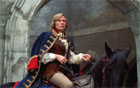
Captain Kronos (Horst Janson) rides across nineteeth century Europe accompanied by his associate Professor Grost (John Cater), seeking out evildoers. His travels lead him to the hamlet of his old army friend Marcus (John Carson), who tells him that local girls are being found mysteriously drained... not of blood, but of youth. Kronos and Grost immediately suspect a vampire, but how to destroy it? And who is the vampire, anyway?
To inject some new life into Hammer's flagging fortunes, Brian Clemens and producer Albert Fennell (of TV's The Avengers fame) were recruited and this is the tongue-in-cheek film Clemens scripted and directed to revitalise the studio's vampire genre. It was planned as the first in a series, but sadly, Captain Kronos was not a financial success, and no more was heard of the character. Adding a swashbuckling hero to the overfamiliar mix was a good idea, although Janson himself is a little bland, and Clemens contrives a welcome array of eccentricities around him.
Kronos is a bit of a lad, far removed from the Van Helsing of the Dracula movies. The know-it-all Van Helsing aspect is carried by Grost, a hunchbacked folklorist, who has the experience to match the skills of Kronos (and who looks as if he has a duvet stuffed up the back of his shirt). Our hero, however, looks like Bjorn Borg and acts like Peter Wyngarde, with a taste for fine cigars and brandy, and Caroline Munro for a girlfriend. I'm surprised he doesn't roar around the countryside in a Jag.
Clemens knows he has a hackneyed story to work with, so he dresses up the clichés with some clever touches. The vampire has no fear of the cross, and indeed appears as a cross-shaped shadow in a church just before attacking a pious victim. Flowers curl up and die when they are passed by the villain, and, as Kronos and Grost discover when trying to destroy a character who has been vampirised, it is difficult to dispatch: stakes, fire and hanging have no effect.
All the evidence points to the Durwards, a family of noblemen and women who adopt a superior air and exploit the peasants. There is a twist in the tale, which isn't particularly shocking, but does provide us with the swordfight we've been expecting, and a good one it is, too. Previously Kronos has been bullied into action by Ian Hendry, unfortunately with not much in the way of swordplay, but he really proves himself a reliable hero by the finale. It's a pity Hammer weren't keen on what Clemens devised, because this film would have been the ideal starting point for an enjoyable series once the hero had found his feet in a sequel. Music by Laurie Johnson.