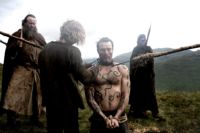
They call him One-Eye (Mads Mikkelsen), a Viking warrior who has been captured by a Norse tribe and put to work as a fighting slave, engaging in combat for their entertainment. He is apparently unbeatable in spite of spending his contests tethered by a rope to a pole, and always finds a way of getting the better of his opponent, killing them without mercy. But he is biding his time for the chance to escape, as is the young boy (Maarten Stevenson), also a slave, who attends to him when he is caged up between fights, although they neither of them have no idea how to get home...
Way, way back in time - no, not that far back, not the Viking times, more the nineteen-seventies - there was a film called The Norseman which detailed the adventures of a group of, well, Norsemen who were led by the Six Million Dollar Man to the New World of North America. That film, as with this one, took itself very seriously only in this instance found itself laughed off the screens and never attaining classic status, more something to leave the unwary viewer incredulous when they stumbled across it on television every so often. Valhalla Rising adopted a very much more arty approach to the same subject matter, with the result it won more than simply a following among bad movie enthusiasts.
However, there were just as many people complaining that writer (with Roy Jacobsen) and director Nicolas Winding Refn had made a work that was worse than laughable: it was plain boring. If the thought of a movie about Vikings brought to mind Kirk Douglas and Tony Curtis doing battle amidst the longships and fjords, then the presentation here, which was mainly Scotsmen standing about in Scotland looking meditatively at the landscape, which is the way that most Scotsmen like to pass the time, might have left you as cold as the weather there. There were bursts of violence, but not enough to sustain the casual viewer hoping for a pulse-pounding thrill ride set hundreds of years ago.
Mikkelsen was of course not a Scotsman, but Refn got around the problem of him not having the same accent as the other cast members by rendering him silent from the beginning to the end. If you knew the Caledonian scenery at all, then you may have considered its standing in for North America somewhat distracting, as after a while the film began to resemble one of those battle re-enactment days out. Not that Refn really had enough cast members for an epic, but then that's not really what this was about, visually at least, as he was more aiming for the grandiose sense of spiritual questing rather than spending money he did not have on those longships.
Actually, he only had one longship, which is where the middle of the movie took place, as after they escape One-Eye and the boy stumble across some Christian Norsemen, newly converted and eager to hotfoot it over to the Holy Land on a Crusade. This is where they get onto the script's contemplation of Christianity versus Paganism, where it adopts the opinion that the later religion was a mere usurper, and the older one it took the place of had more integrity, even going to the extent of staging a Christ-like sacrifice at the end which shows you did not need their God to inspire such generosity of spirit. But most of this is wandering about those hills in freezing conditions, and no matter what Refn endeavoured to inspire in the minds of those watching, many will be thinking of Monty Python and the Holy Grail; OK, it was a different period of history, but that film dogs low budget filmmakers trying to recreate the Dark Ages and medieval times, and Valhalla Rising was little different. Music by Peter Peter and Peter Kyed.