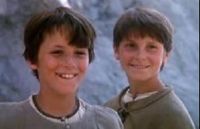
A young Swedish orphan named Bosse (future Hollyoaks regular Nicholas Pickard) lives in misery with his cruel old aunt and uncle, until one night he is whisked away to the magical land of Faraway. Here he discovers that his real father is the King of Faraway (Timothy Bottoms) and he is Prince Mio. Alongside his friend Jum-Jum (Christian Bale), Mio sets out to defeat the evil knight Kato (Christopher Lee) and free the children he has kidnapped.
Mio in the Land of Faraway was based on a novel by Astrid Lindgren, best known as the creator of Pippi Longstocking (1969) and a prolific and much beloved author in her native Sweden. Although now best remembered for marking the screen debut of young Christian Bale, starring opposite the original "dark knight" Sir Christopher Lee, at the time this Swedish-Norwegian-Russian co-production was more notable for being the most lavish Lindgren adaptation to date. The big budget encompassed lavish production values: beautiful cinematography that makes Faraway a luminous and heartening pastoral fantasy land, modest but effective special effects by Derek Meddings - a regular contributor to the James Bond films - and a lovely theme song composed by former ABBA members Benny Andersson and Bjorn Ulvaeus that lingers longer in the memory and conveys the underlining themes far more eloquently than the film itself. Hindered by the heavy-handed direction of Vladimir Grammatikov, Mio is sadly lacking in magic.
Two previous epics, The Brothers Lionheart (1977) and especially Ronja Rovardotter (1984), had been enormous critical and commercial hits in Sweden but both were scripted by Lindgren herself. She had no creative input here and it shows. Swedish reviewers criticised screenwriter-producer William Aldridge for supposedly Americanising the novel and making a muddle of Lindgren's themes in an obvious bid for the same success enjoyed by another European children’s blockbuster, The Never Ending Story (1984), but actually such accusations don't hold up to close scrutiny. The opening scenes are set in Stockholm and the film draws more from the twin traditions of Swedish and Russian children's filmmaking than the Hollywood model.
A staunch advocate of children's rights, what makes Lindgren's original novel so achingly poignant is that it fundamentally embodies the fantasies of a neglected child and his simple longing for a loving parent or even just a few encouraging words. Prior to his flight to Faraway, Mio is shown sitting alone in the freezing cold, a fact that coupled with his final melancholy glance to camera (and that touching theme song) implies everything we have seen has been the fantasy of a dying child. An idea that would be far more unsettling had Grammatikov endeavoured to make anything out of it, or the conceit lifted from the movie version of The Wizard of Oz (1939) where people from the real world have doubles in Faraway. Mio shrugs off Jum-Jum and the king's resemblance to his real world friends rather too easily.
Charismatic Christian Bale easily overshadows the bland Nicholas Pickard, whose flat line readings thwart the promising subtext. The script is heavily reliant on Bosse/Mio's voiceover but he never really learns anything to makes his journey seem worthwhile. Most of the guest stars, including Bottoms and Susannah York as a magical seamstress, add nothing but Christopher Lee brings his customary gravitas to the glowering, if poorly written villain. Mio was a hit in Sweden, where pop group Gemini also scored a top three hit with the theme tune, but has to be chalked up as a missed opportunity and arguably a rare movie worth remaking.