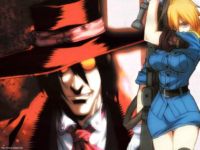
Adapted from a manga by Kouta Hirano, this stylish and often inventive horror-action anime displays a fascination with British popular culture that may beguile U.K. viewers. Co-produced by Studio Gonzo and Pioneer, this thirteen-part television serial is more successful at fusing steampunk action and gothic horror than was managed in its mega-budget namesake, Van Helsing (2004). Long-time anime fans may notice certain stylistic parallels it shares with fan-favourite Vampire Hunter D (1985), though the script written by veteran Chiaki Konaka is more substantial.
Sir Integra Van Hellsing (voiced by Yoshiko Sakakibara), an interestingly androgynous but actually female descendent of the original vampire slayer (who strictly speaking, ought to be called “Dame”), heads the Hellsing Organisation, a secret government unit tasked with eliminating a new breed of chip-implanted artificial vampires. Their chief weapon is Alucard (Joji Nakata), a true vampire who has served the Van Hellsing family for generations and, as any fans of Son of Dracula (1943) and Dracula A.D. 1972 can guess, is probably you-know-who. The opening scene recalls that horror anime classic Wicked City (1987), as a horny salaryman gets more than he bargained for with a vampire dominatrix until Alucard rides to his rescue. Dressed like a gothic Superfly with scary eyes and a Mick Jagger tongue, Alucard blasts the vampire vixen with a Dirty Harry calibre hi-tech pistol. In later episodes he is able to slay the undead with just a swipe of his hand and occasionally shape-shifts into a many-headed hound of hell. Alucard preens like a rock star and amusingly disdains these lesser vampires as “trash” or “cockroaches”, but bonds with wide-eyed police officer Victoria Sellers (Fumiko Orihasa), whose life he saves by turning her into a vampire. Sellers promptly joins the Hellsing Organisation and becomes our viewpoint character.
At first Sellers’ meekness and naivety grate on one’s nerves. Remarkably inept and vulnerable even for a rookie police officer, her mini-uniform is seemingly intended to titillate although Ryoji Nakamori’s character designs lack sex appeal. She slowly grows in confidence under Alucard’s tutelage while her struggles coping with a vampire’s bloodlust become a potent subplot. The series consistently highlights interesting ideas even if the storytelling gets a little obtuse. Episode Two features Bonnie and Clyde, teenage delinquent vampires who slaughter whole families then hang around to make-out amidst piled corpses. Alucard chastises them for revelling in sadism for amusement instead of killing mercifully and out of a need for food, while Sellers kills her first vampire.
Episode Three introduces an intriguing clash between Protestant and Catholic vampire hunter organisations. The pursuit of a gay vampire tragically searching for his lost love is complicated by the arrival of Alexander Anderson (Norio Wakamoto), a psychotic blonde punk Vatican priest/secret agent, who proves more than a match for Alucard. While their confrontation proves anti-climactic, it is surely a set-up for a conflict yet to come. London-based anime fans may enjoy seeing locations featured in the show, although quite how a horny priest picks up a prostitute in broad daylight at Piccadilly Circus, I’ll never know.
By far the most interesting is episode Four wherein an ex-SAS soldier takes command of the unit and a snuff viral website threatens to expose the Hellsing Organisation to public scrutiny. Several set-pieces foreshadow the DV cam sequences in I Am Legend (2007), while the plot develops into an interesting debate about free press and government censorship in the face of terrorism, that is very topical. The dark conclusion does not paint our heroes in an entirely favourable light. The series is also notable for using interestingly offbeat sound-effects, such as a telephone bell whenever Alucard teleports. And listen out for Johnny Weissmuller's Tarzan yell during one sudden vampire attack. The soundtrack is also top-notch, especially the jazz-rock opening theme, although the closing number - composed by an American soft-rock duo recalls Bon Jovi and is something of an acquired taste. Surprisingly, fans criticised Chiaki Konaka’s intelligent scripts for being less-than-faithful to the original manga and the anime was resurrected as a series of feature-length OAVs titled: Hellsing Ultimate. Either version is worth checking out.