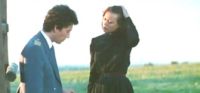
Miss Hobbs (Jenny Agutter) thinks she has a strong psychic link to the other side, and is intrigued by the feeling she gets on this afternoon as she sits on a bench by an open parkland and senses that something is about to happen. She is still there an hour later when night has fallen, but that premonition turns to terror when she sees what is happening: nearby a passenger aircraft has taken off, with the captain, David Keller (Robert Powell), thinking that everything is going to plan when suddenly there is an explosion on board and the plane is sent hurtling towards the ground...
James Herbert is one of Britain's, nay, the world's bestselling writers of horror, but unlike one of his peers, Stephen King, for some reason filmmakers have never really lined up to adapt his novels in spite of their apparent ideal fit with the trends in genre cinema over the years. So while readers have lapped up his gory tales on the page, in the cinema a mere handful of his output has been translated, and not one of them has been especially satisfying either to the fans or the casual viewer, not least Mr Herbert himself, although he could have been consoled by the fact that the best way to enjoy his work is to buy his books.
The Survivor was the first of his oeuvre to be adapted for film, and rather than go for the creepy atmosphere of the source, which frequently erupted into violence largely missing from the movie, the director, actor David Hemmings, imported to Australia after falling in love with the place when working on vampire flick Thirst, opted for a dreamlike tone. This was all very well, as there were plenty of fine chillers to take this tack, but the results here were more confusing and confounding to those who were not already familiar with the story than anything else, with too many unanswered questions stemming from a script by David Ambrose that refused to fill in too many blanks. What you have is Keller surviving (hence the title) the plane crash miraculously unscathed, and spending the next ninety or so minutes trying to work out why.
He is assisted in this by Hobbs (Agutter replacing the Donald Pleasence-alike medium of the novel with a more photogenic character), who witnessed the crash and is now convinced that the spirits of the dead are speaking to her and telling her to contact Keller, indeed according to what we hear on the soundtrack the deceased are screaming through her clairvoyant mind. What it is exactly they want to tell him is somewhat lost in the murky plotting, and Ambrose adds elements from the original, such as subplot characters meeting nasty ends, without telling us of their relevance to the overall narrative, and by the end you may still be wondering what it was that that prompted the dead to bump off those two people for, because explanations are not forthcoming unless the act of being a ghost makes you wish to kill (it was justice they were seeking, in case you missed it).
This would have made more sense if they had retained one of the Herbert's villlains, the elderly Nazi who becomes chief suspect for the supernatural evildoings after he dies in the crash, but as it is when the other bad guy is revealed in the film for the finale, his motives are something you feel you might have missed, so vague are they on the specifics. This leaves you with Powell and Agutter drifting through various scenes, all far too restrained, and building up to a twist in the denouement that anyone who has read Occurence at Owl Creek Bridge won't be massively surprised about. Yes, that's true enough to the novel, but there was a measure of substance there which here comes across as far more casual. There were two versions released, one superior, longer cut and the other, briefer re-cut that was more widely seen and sabotaged the particular, careful rhythm of Hemmings' original, but the way it doesn't hang about means it's not wasting too much of your time, and the plane crash was impressively staged (with a real aircraft), one of the biggest stunts in an already stunt-filled Australian exploitation cinema, if nothing else. Music by Brian May.
[Severin's Blu-ray of The Survivor has as many special features as you could ever want, with a fully restored, full length version of the film accompanied by a audio commentary, interview clips, James Herbert featurettes, trailers and so on. It's possible to appreciate the film far better now: Herbert didn't like it originally, but he may have liked this.]