One dark and stormy night over the city, a book falls through the rain and lands on the ground for someone to pick up. Soon after, a curious phenomenon begins to occur as first a criminal on the run who takes a hostage keels over from a heart attack, then a corrupt government employee who has links to organised crime suffers the same fate, and a murderer who has emerged from the courtroom having been freed dies too. And so it continues, with the internet awash with rumours that someone they name Kira is committing the deaths by supernatural means, wiping the world of criminals...
Death Note, or Desu nôto as it was in the original Japanese, was based on a cartoon series which in turn had been based on a popular comic book, and was the first in a two-part adaptation that had both instalments released within months of each other in its native land to keep the interest in the project alive. Therefore, yes, this is one of those films that ends on a cliffhanger and fully expects you to turn up for the next part, but that does not matter so much if the first has been so gripping: see the original Star Wars trilogy for the most obvious example. Alas, Death Note was not quite up to that level.
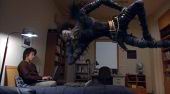
Not that it was bad, it simply seems as if what would have been perfectly fine on television in animated form came across as a little lacking and frankly a lot contrived in the cinema. The central idea, that this notebook will kill any person whose name is written inside, is dropped by a demon, or god of death if you will, needs far more of a suspension of disbelief that live action can bear, and when the demon shows up to frequently look over the shoulder of the chap who is in possession of the book he is a none-too-convincing item of computer animation that looks like something off a heavy metal album cover, and moves about as realistically as you might then expect.
That owner of the Death Note book is Light Yagami (Tatsuya Fujiwara), who happened to pick up the offending pages after an encounter with some young hoodlums that he was powerless to do anything about. A law student, he finds the authority he aspires to is not enough when he wants a more immediate action to deal with the criminals, so the notebook is a gift from heaven. Or hell - he quickly allows these forces to go to his head, and is soon mopping up any evildoer he can once he reads about them in the newspaper or sees them on television. All he need do is picture the specific victim as he writes down their name and they will die forty seconds later of a heart attack.
There are other conditions, and these are helpfully written in the inside cover, so that Light may pick how the victim dies if he details the conditions of their demise, although considering the amount of people he is supposed to be offing, it's amazing that he can fit all this information into what is a pretty flimsy jotter. The moral question of how far you can go to eliminate evil without turning evil yourself is mused over, then relegated to the background as it becomes clear that Light has become hopelessly corrupted, and effectively transforms into the film's bad guy. He does not go unchecked, however, and soon a detective team are on his trail led, in an unlikely coincidence, by his inspector father (Takeshi Kaga), who is assisted by the mysterious L, a secretive mastermind who can solve any crime although even he finds that proof in this case is hard to come by. Death Note layers on the twists in thriller fashion, but is too lightweight to truly inspire. Music by Kenji Kawai.