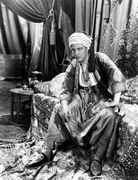
Somewhere south of Algiers, a group of bandits are gambling in their camp. The sole female member of the party is Yasmin (Vilma Bánky), who they use to drum up money with her dancing moves, but really they're not seasoned entertainers, more criminals even if Yasmin is an innocent forced into these situations thanks to her cruel father. However, there may be light at the end of the tunnel for the girl, as recently she has met the dashing Ahmed (Rudolph Valentino), the son of the Sheik of these lands, and they have made an arrangement to meet at the old ruins that night - little do they know of the trouble ahead...
There aren't many men who can get away with wearing eyeshadow, but Valentino was one of them, as illustrated by his appearance in this, his final film before his untimely death. All the more untimely in that it was the biggest hit of his career as a sequel to his previous big success of five years before, The Sheik, although that was more down to the fact that he had passed away and the resulting, worldwide publicity that accompanied it. Here at least he was trying to demonstrate he had more range than the average matinee idol, as he not only took the role of the son, but his dad too, playing the character he had essayed in the previous film as an older man.
There's a gimmicky nature to this casting, and it's fun to see the way they got around too many shots of putting the two Rudys together, although there is one shot where they grasp each other's arms while in the midst of combat for maximum stirring of the emotions. Not that Valentino's fans needed much encouragement to swoon over their hero, although by this time the star had long grown uncomfortable with his screen image and was feeling straitjacketed by his fame. Still, you wouldn't know it by the gusto he launched himself into this, throwing smouldering looks around as if they were going out of fashion.
There's more than a little of the fetishism about the romantic entanglement at the heart of the film, as a "I love to hate you" theme emerges soon after Ahmed turns up at the ruins for a canoodle with Yasmin, only for her bandit gang to creep up and ambush him, leaving him tied up, chest bared and looking very much the figure of female bondage fantasies. Ahmed's men rescue him and he escapes, vowing revenge because he thinks it was a set up and Yasmin was in on the scheme - but she wasn't! Nevertheless, he tries to get his own back by kidnapping her, and then we get into some unsavoury female domination fantasies as the hero eschews all that kissing for an implied rape.
We don't actually see him got through with the assault, but you can read between the lines. It's safe to say that heroes of romantic adventure blockbusters would not behave that way these days, but the 1920s were a different time, as you can see by the racism: the most evil character is the darkest-skinned, the devious Moor Ghobah (Montagu Love) who means to have Yasmin all to himself after her father promised her to him. Even Ahmed, who you would imagine would be Middle Eastern at the very least, is announced in a title card to be of English origin, as if the filmmakers were reluctant to have Valentino play a non-white character. If you can stomach this kind of outdated prejudice, then there are compensations as the breezy tone of derring-do provides some enjoyment, with Rudy's charisma in little doubt, and if nothing else you can marvel at how forgiving the lovers are when they get back together, no questions asked.
[Eureka release this on Blu-ray with the following features:
Presented in 1080p from a high-definition digital restoration, with a progressive encode on the DVD
DTS-HD MA 5.1 and uncompressed 2.0 audio options on the Blu-ray
Loitering Within Tent A brand new video essay by David Cairns
Introduction to the film by Orson Welles
A collector's booklet featuring a new essay by critic and film historian Pamela Hutchinson]