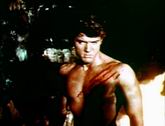
Scotland, 1550: hideous witch Martha Gunt (Hélène Chanel under witchy makeup) is burned at the stake but goes out like a pro. Spewing curses at the torch-wielding peasants led by hypocritical Judge Parrish (Andrea Bosic), she vows vengeance from beyond the grave. One hundred years later, honeymooning newlyweds Charlie (Angelo Zanolli) and Martha (Vira Silenti) fall afoul of local hysteria when village idiots start blithely accusing all pretty women of witchcraft, in scenes straight out of Arthur Miller’s The Crucible (1996). As soon as these jackasses learn Martha shares the witch’s name, they throw the poor, confused woman in jail. Just as she is about to be hung from a noose, along rides loincloth-clad, muscular superhero Maciste (Kirk Morris) to save her.
Whoa, wait a second. What is a semi-naked muscleman from Ancient Rome doing in 17th century Scotland? And doesn’t he feel cold? Well, there is a perfectly logical explanation but, damn it man, a woman’s life is at stake - there’s no time!! Despite Maciste’s timely intervention, Martha decides to clear her name in court. Things go awry when her touch sets a bible aflame and nobody else hears the witch cackling from the depths of hell. Martha is resigned to being flame-grilled like her ancestor, while Charlie mopes around presumably regretting they never settled for a nice cruise in the Caribbean. Seriously, who honeymoons in an asshole-of-nowhere village when there are so many nicer spots in the Highlands? There is only one thing Maciste can do: uproot the witch’s cursed tree and plunge into hell itself to confront the witch and her wicked minions. Cool beans!
Though his films have been sold in the English language as Samson or Hercules adventures, Italian peplum (a genre named after the classical garment worn by its leading men) hero Maciste has been around since the silent era beginning with Giuseppe Pastrone’s Cabiria (1913). Written by soldier-poet-fascist Gabriele D’Annunzio, this proto-epic mixed historical characters with fictional ones and made a star out of former longshoreman Bartolommeo Pagano, who appeared in somewhere around twenty-nine Maciste movies between 1914 and 1928, including the original Maciste All’ Inferno/Maciste in Hell whose title (if nothing else) is borrowed for this 1962 film also known as The Witch’s Curse.
Following the international success of Pietro Francisci’s Hercules (1957) starring Steve Reeves, Maciste was revived and portrayed by an array of all-American musclemen including Mark Forest and onetime Tarzan, Gordon Scott. Kirk Morris was a stage-name for a rare Italian lead, Adriano Berlini, a former gondolier who headlined some of the zanier entries in the genre including the delightful Conquerors of Atlantis (1965).
Along with Mario Bava’s Hercules in the Haunted World (1961) and Sergio Corbucci and Giacomo Gentilomo’s Goliath and the Vampires (1962), The Witch’s Curse ranks as one of the best horror peplums, if one readily accepts its unorthodox melding of Hammer horror with mythological romp. Less phantasmagorical than Bava’s vision of Hades, veteran director Riccardo Freda (who kick-started the Italian horror boom with I Vampiri (1956)) creates an unsettling vision of Hell with legions of scrawny, wailing sinners tormented by blue-skinned demons or imprisoned in icy caskets, and a grey, decayed colour palette that compares with Lucio Fulci’s The Beyond (1981), but offset with magical flourishes like a snowfall or shower of sparks. His special effects, while archaic, are executed with flair. Most notably a door in hell that catches fire with flames that then follow Maciste’s every step.
Wrestling a lion (in an impressive scene cut from the American print), live pythons, fending off a cattle stampede and a caber-tossing giant, heckled all the while by the omniscient witch and former witch hunter-turned-sidekick, Maciste endures an almost Christ-like suffering and at one point extends his bloody hands towards the viewer. Kirk Morris’ strongman hardly speaks a word, yet despite his considerable thespian shortcomings emerges an enigmatic, wholly altruistic superhero who puts his muscle in the service of others. “My destiny is to help people who are suffering oppression and cruelty all over the world”, he intones in his farewell speech.
However, Freda adopts a slightly more complex view of good and evil. Self-righteous Judge Parrish shares his victim’s hell-bound fate, having burned her solely for spurning his advances when younger and prettier. Maciste encounters beautiful blonde Flavia, who heals his wounds and guides him on his way. Since Flavia is played by Hélène Chanel, who minus witchy makeup is far from ugly, we know she is more than she seems. Yet touchingly she is moved by Maciste’s goodness away from vengeance to love.
Things do get pretty ropey at times, especially when Maciste encounters the eternally suffering Prometheus (Remo De Angelis) whose magic pool of fire displays a sort of greatest hits package of clips culled from Atlas in the Land of the Cyclops (1961), Son of Samson (1960), and Samson and the Seven Miracles of the World (1961). Ostensibly to revive the hero’s memory but really to pad out the film! Given the genre, a happy ending was never in doubt, but do any of those bastard villagers say sorry? Nope.