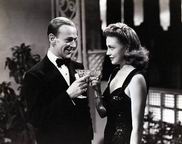
Fred Atwell (Fred Astaire) is one of the famous "Flying Tigers", a group of American fighter pilots who have gained renown for shooting down a record number of Japanese planes, with Fred the finest of them all. However, the limelight does not suit him, and when they return home to a hero's welcome he is not comfortable with the tickertape parades and grand dinners held in his honour. When he is on a train with his fellow servicemen to travel the country in his week of leave, he decides he's had enough and as the locomotive stops briefly, he jumps off and heads for the nearest town. He'll be back at his post soon enough, so why not enjoy his time away?
Astaire had good reason to appreciate The Sky's the Limit, as here he was given the chance to design his own choreography, something he did with some degree of flair, although fans might be wishing there was less of the chit-chat and more of the hoofing. His partner in this was Joan Leslie, a former child star who was making the move into grown up roles, and acquitting herself very well indeed, proving a bright and appealing presence and keeping up with the dancing with apparent ease. As this was made in 1943, it was an RKO propaganda production, but nothing overbearing in the flagwaving was here.
Instead, there was a lighthearted style to it all which almost imperceptably grew darker as it went on, as if to remind us that the day of Fred's return to the skies was becoming ever more imminent. He ditches his uniform and buys a suit and hat (and boots) that make him look like a Texas cattle baron, although when he finally ends up at the swanky nightclub where he meets Leslie's shutterbug Joan Manion he manages to blend in. It's love at first sight for Fred (with Astaire playing younger than his years), and he begins a ploy to make Joan notice him that veers perilously close to stalking, though as it's this star doing the pursuing his legendary charm wins the day.
Besides, we can see the hints of desperation and dissatisfaction that brings the hero to the state he's in, an unusual character for the time in that he takes no relish in killing the enemy even if he's very good at it indeed. We're in no doubt that Fred accepts his duty, but there's a melancholy to his personality that deepens him in what could have been strictly fluff. As it plays out, Joan is initially put off by his badgering of her (imagine Robert De Niro in New York, New York to see how nightmarish this could have been with the wrong actor), but when Fred's air force buddies make an entrance and tell him his leave is shorter than he anticipated, a change occurs in the overall mood.
Now, Fred is trying to offer Joan happiness by setting her up with her boss, Phil Harriman (Robert Benchley, working wonders with a terrible speech skit later on), who secretly loves her, but by this stage she has fallen for Fred and cannot understand why he appears to have lost interest. This would have provided material for a string of Astaire musicals during the thirties, but with the war looming over the character's lives there's a notable sincerity to their plight. It does lead to one of the star's best routines, where he wanders the bars getting drunk and singing Johnny Mercer and Harold Arlen's "One for My Baby (and One More for the Road)", the film's most celebrated tune, then breaking out into a superb dance where he smashes up a bar as the only patron in the place. If The Sky's the Limit doesn't match the very best vehicles for Astaire, it does have gems like that within that make it worth your while.