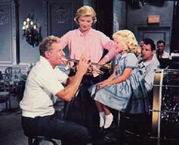
This warm-hearted musical biopic opens in 1924 where coronet player Red Nichols (Danny Kaye) joins a dance band led by acerbic crooner Will Paradise (Bob Crosby), who swiftly scorns his complex compositions. Friend and band-mate Tony Valani (Harry Guardino) cajoles Red into a double-date with singer Bobby Meredith (Barbara Bel Geddes), who spikes his drink as a practical joke. Red drunkenly stumbles onstage with none other than Louis Armstrong (playing himself) and, after a shaky start, blows the crowd away with his madcap musical stylings. Shortly after marrying Bobby, Red quits Paradise’s band and the couple form their own Dixieland band named The Five Pennies - a play on Nichols’ name, since a nickel equals five pennies - recruiting such no-hopers as Glenn Miller (Ray Daley), Jimmy Dorsey (Ray Anthony) and Artie Schutt (Bobby Troup).
Although raising their little daughter Dorothy (Susan Gordon) on the road proves tough, the band play to packed crowds and rack up the hits. Despite enjoying a close relationship with Dorothy, ever-ambitious Red foolishly consigns her to a boarding school while he goes on tour. When Dorothy is stricken with polio, a distraught Red quits show business and devotes his energies to seeing his little girl walk again.
Much like Melville Shavelson’s earlier The Seven Little Foys (1955), this is a musical biopic about the tensions between showbiz and family life. The star of that film, Bob Hope makes a blink-and-you’ll-miss-it cameo here. But whereas Eddie Foy sought a solution by working his family into the act, Red Nichols walks away from glitz and glamour for the good of his child. A plot twist that must have appealed to Danny Kaye, who himself became a UNICEF ambassador for sick children.
The heart of the movie lies with Red’s relationship with Susan, ably played by sprightly Susan Gordon as a five year old before she blossoms into beautiful Tuesday Weld, and steadily plucks the heartstrings as each lifts the others spirits when at their lowest point. Whether it’s Red making Dorothy laugh when she lies in agony, or Dorothy cajoling her dejected dad into a comeback. Added poignancy arises from Red forced to watch onetime employees Glenn Miller and Jimmy Dorsey rise to superstardom during the War years while he toils anonymously in the shipyards. His life comes full circle in an achingly sad scene where he proves unable to play the horn to convince Dorothy’s clueless teenage friends he was once a swing superstar.
A multi-talented performer, Danny Kaye shows off his verbal dexterity via some scat-singing and croons an array of wholly delightful songs penned by real-life wife Sylvia Fine (whose work along with the score by Leith Stevens was Oscar nominated) alongside jazz standards like his duet with ol’ Satchmo on “When the Saints Come Marching In”, although the coronet playing was dubbed by the real Red Nichols. The film yokes humour from some of the zanier episodes in Red’s career, including brief stints in Hawaiian, Eskimo, Cossack and Canadian Mountie-themed bands, with plenty of comic buffoonery from Kaye but is a largely a dramatic vehicle for the star. He rises to the challenge, aided by a terrific supporting cast including future Dallas matriarch Barbara Bel Geddes, and sparking that crucial chemistry with youngsters Gordon and Weld.
Exceptionally well photographed by Daniel I. Fapp (who was similarly Oscar nominated) in neon pinks and reds, the film features a number of ingenious visual flourishes that lend it the air of a jazz fantasy. Note Louis Armstrong emerging from a darkened stage with a spotlight on his soaring golden horn. Or Dorothy’s dreamy late night jazz reverie at the club where she watches goggle-eyed while her daddy duets with Armstrong. The musical numbers are brilliantly staged and suitably toe-tapping, although the film wisely never shies away from the harsher aspects of show business. It also shows staging a comeback isn’t so easy, as Red plays empty rooms until several old pals join him onstage for the joyous, feel-good finale. Guaranteed to not leave a dry eye in the house when dad and daughter learn to “stand on their own two feet.”