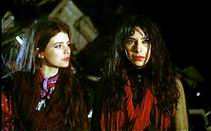
Marie (Christiane Coppé) is a patient at an institution for women with mental health problems, because she refuses any interaction and prefers to sit and stare into space, as she is doing now while sitting in a rocking chair. However, someone is about to wake her up when another inmate tries to attract her attention: she is Michelle (Laurence Dubas) and in personality is the opposite of Marie, a violent, raging girl who is scheming to escape from the asylum. She persuades Marie to open her door and take off her straitjacket, not realising that she has commenced a new friendship...
The Escapees, or Les paumées du petit matin if you were French, was long considered director Jean Rollin's lost film, but it wasn't lost, it was simply gathering dust as a work which did not fit into the horror or sex genres that he usually produced. For those expecting beautiful women doffing their clothes in an atmosphere of dreamlike chills, well, the atmosphere was still there, but there wasn't much nudity until the very end and the chills were non-existent. Rollin didn't think much of this effort due to being displeased with the script, so another reason it disappeared for so long was that he wasn't interested in pushing it.
Now it is more widely available, it's easy to see why it wasn't embraced by its creator. A conscious attempt at trying something different, this is more of a low key drama than the thriller that it keeps threatening to turn into, and the oppressive air of melancholy keeps it from being anything but glum. Even the short stretches where Rollin allows his two lead characters to lighten up and let their hair down are laced with sadness, with only the manner in which their relationship has developed preventing a hundred minute wallow in all-out misery. And yet it is still recognisably a Rollin film, it's just that he seems to have been in a low mood when he made it.
At first Michelle doesn't want to know Marie at all, and runs off immediately after they are free from the institute's grounds, but the sound of the shy girl weeping makes her guilty and she goes back to drag her along with her. They end up near the docks and a makeshift "exotic dancer" show put on for the sailors who are on leave; the two girls make some money serving drinks to the rowdy seamen while the entertainment is going on. One of the men in charge notices they are looking down, and sympathises with them that the members of the show all used to be bona fide performers and are now reduced to this: why does this seem to be Rollin speaking through his characters?
If it is possible to read too much into The Escapees, it is only because the narrative is so strangely unadorned and plain. Despite that, there are some unexpectedly touching moments, as when Marie reveals she was in showbusiness herself not so long ago, taking to an ice rink to dance (I don't know anything about Coppé, but one assumes she was cast for her skills in this area) with only Michelle looking on from the shadows. These two are damaged souls, and the film has a lot of empathy with their plans for freedom that are doomed to come to nothing. They hope to leave France on the next ship, but a fateful meeting with a group of decadent upper class types (one of them Brigitte Lahaie, the most familiar face here) puts paid to that. It's too slackly handled to be truly compelling, but its dejection makes it quietly affecting - or at least as quiet as that gunfight climax can be. Music by Philippe D'Aram.
A lifelong film fan, French director Jean Rollin worked consistently since the 1950s, but it was his horror films that would bring him most attention, starting with Le viol du vampire in 1968, a work that caused a minor riot on its initial showings. This showed Rollin the way to further dreamlike entertainments, often with a strong sexual element. Other films included Le vampire nue, Le frisson de vampires, Les Raisins de la mort, Fascination (often regarded as his masterpiece), The Living Dead Girl, Zombie Lake and a number of hardcore porn features. He was working up until his death, with his latest Le Masque de la Meduse released the year of his demise.