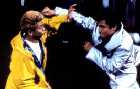
In a post-apocalyptic Japan, the corrupt Dictator Woo of Yokohama (Richard Chen) has largely outlawed reproduction, forcing the female population to take birth control pills. Officer Honda (Riki Takeuchi) is Woo’s chief enforcer, and one of the few allowed to have a child. Into town comes Ryô (Sho Aikawa), a mysterious stranger with seemingly superhuman agility and fighting skills.
Like Part 2, Takashi Miike’s third Dead or Alive film is only connected to the first by pitting lead actors Aikawa and Takeuchi against each other, and in comparison with much of the director’s work is a somewhat sedate, almost thoughtful slice of tongue-in-cheek sci-fi. Shot in Hong Kong with both Japanese and Chinese actors, Miike creates a decent enough future vision on a budget – there’s some good matte shots of giant ships passing over the city, and the film is shot on digital video through a yellow filter, presumably to create the sense of a polluted environment.
While not as fast-moving as earlier Miike thrillers like Shinjuku Triad Society, Dead or Alive: Final does pick up the pace from its two predecessors, and replaces the brutal violence of the first with some exciting martial arts/gunplay (assisted by a HK stunt-team) and even a spot of bullet-time effects work. There’s probably not enough action, but it’s good to see the director trying his hand at a different type of on-screen violence.
Once Ryô hooks up with a gang of rebels and we learn that he is in fact an android, the film drops a notch as he gets to spend some time with foxy rebel Jun (Josie Ho) and her young son. There’s a quietly affecting bonding scene on a beach and even a restrained woman/replicant love scene, but I couldn’t quite escape the feeling that the story was being stretched somewhat thin over 90 minutes. And Dictator Woo makes for a very dubious villain –a psychotic homosexual who wants to outlaw hetero-reproduction and lusts after the bare-chested sax-playing minstrel that accompanies him everywhere... hmmmm. But let’s face it, you don't look for good taste and positive role models in a Takashi Miike film.
There’s a confusing climatic attempt to draw all three movies together, plus some pretty cool Tetsuo-style mecha-violence, and while nothing could possibly top the insanity of the first film’s ending, this one's is still w-a-y out there. Certainly not Miike’s best, but still intriguing.
Japan’s most controversial director, notorious for his dauntingly prolific output and willingness to push the boundaries of taste. Miike started working as an assistant director in the late 80s, before moving into making straight-to-video thrillers in 1991. He made his feature debut in 1995 with the violent cop thriller Shinjuku Triad Society, and since then has averaged around seven films year.