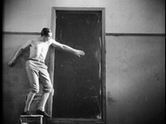
An artist (Enrique Rivero) is having difficulty with his portraits, unsatisfied with his results until he notices that the mouth on one he has just sketched is moving, as if trying to speak. Horrified, he takes his hand and scrubs at the charcoal, and it is then there is a knock at the door of his apartment; opening it, he is given a message by the man standing there, who then rushes off as fast as he can without offering a reason. It is then that the artist notices his palm: there is a mouth in it, moving as if trying to speak...
That imagery of art attempting to articulate itself is returned to again and again with this, the first of Jean Cocteau's films, which number surprisingly few considering the impact they had. It's all swooningly romantic, as long as you take into account that what Cocteau is being romantic about are his own creative processes, and placing the need for the artist, for which read himself, to express himself as well as he possibly can even as he knows that not everyone will understand - this film goes out of its way to be mysterious in its visions.
Blood of a Poet is usually lumped in with the surrealism of its era, especially since it was funded by the same couple who put up the cash for Luis Buñuel's L'Age d'or, a classic of the style, but while Cocteau was consciously implementing dreamlike visuals, this is less about is subconscious speaking to him to throw up a random collection of arresting scenes, and more about staying true to his innovative self as he saw it. Again and again we return to the plight of the artist, which can be alienating to those who see such fretting as hopelessly out of touch and that dreaded word, pretentious.
But even if that's what you come away from this film believing, you can't say you have not been given food for thought, in spite of many people's thoughts simply rejecting what they have seen. For those with more sympathy and imagination, they will be swept along by a film that may be primitive in its effects, it was made in 1930 after all and it's not exactly Georges Méliès, but it is striking nonetheless. The artist in the story, such as it is, has a muse in the shape of a Greek statue who springs to life (as soon-to-be photographer Lee Miller) once he allows his new mouth to kiss it, and the weirdness can begin in earnest.
Actually, the low budget can work in Blood of a Poet's favour as the creativity of Cocteau shines through in the minor sequences, such as the snowball fight, just as it does in the more provocative ones. Not only that, but you can see echoes of his future films in this, with its preoccupation with mirrors well to the fore, for instance: the artist is persuaded to enter the parallel world through the looking glass here. Some of what he sees is pretty throwaway, such as the bell-adorned girl escaping the clutches of her whip-wielding mother by literally climbing the walls, and some has a serious, if obscure, message about attaining immortailty through your work, a worry for all the great poets one presumes. You may not be interested in that, but you can be captivated by the representations of the creative forces on display. Music by Georges Auric.