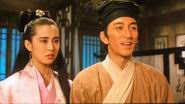
Long ago in China, an abandoned baby floats down river to be discovered by Taoist ghost-hunter, Wu Men-Chu (Wu Ma), who is happily bathing and singing a jaunty bath-time tune. Welcoming this as a sign from God, Wu raises the infant as his student and he grows into righteous swordsman Shih Erh (Yuen Baio). Elsewhere, a wedding procession is attacked by the malevolent King Ghost (Elizabeth Lee), with bride-to-be Mo Chiu (Joey Wong - who else?) cruelly slain and reborn as restless ghost maiden. Years later, Shih Erh befriends gormless scholar Tsui Hung-Chien (Lawrence Ng), inside whose artwork Mo Chiu takes refuge. Having fallen in love, the pair incur the wrath of intolerant Wu, while kind-hearted Shih Erh strives to protect them from the netherworld.
In response to the global success of A Chinese Ghost Story (1987), Hong Kong film giants Golden Harvest snagged its leading lady Joey Wang and co-star Wu Ma to replicate the hit-making formula, with the latter doubling as director. Overshadowed by his role in the A Chinese Ghost Story series, Ma’s distinguished directorial career spanned several decades where, alongside swordplay epics and crime thrillers, he made supernatural adventures like The Dead and the Deadly (1983). He proved the right man for the job, although sadly his subsequent output - including Foxy Spirits (1991), Exorcist Master (1993) and Chinese Ghostbuster (1994) - were entirely imitations, each worse than the last.
While Portrait of a Nymph blatantly apes the flowing silks, dry ice and blue-filtered aesthetics of its famous progenitor (right down to the rapping Taoist!), it introduces a handful of concepts the later Chinese Ghost Story movies would adopt as their own. The father-son relationship between the ghost-busting Taoists compensates for the lacklustre leading man in Lawrence Ng, whose klutzy scholar shares little chemistry with Joey Wong’s lovelorn lady-ghost. While charming as always, Wong is on auto-pilot, clearly marking time between her later, more ambitious supernatural roles. Scene-stealer Elizabeth Lee proves more animated, exuding sensual malevolence as the monster with a vendetta against all brides.
Amidst much philosophizing about love, heroism and justice in an unjust world, this boils down to an intriguing clash between the secular and spiritual worlds, with Wu despairing of mortal men, while the more tolerant and idealistic Shih Erh defends true love. One wonders why the makers didn’t ditch the dull scholar and make Shih Erh their love interest, although his own romantic subplot comes to a tragic end. Wu Ma pads out his plot, taking too long to draw the strands together, but production design, special effects and fight choreography by Sammo Hung are all outstanding.
Grace notes of otherworldly beauty include paper cranes that come to life (an especially charming special effect) , a leap through the portrait into an ethereal world made of flowing white silk and an amazing battle between flying red rickshaws zapping each other like UFOs. Coupled with a poetic ending, these flights of fancy are worthy of Jean Cocteau, which means, while no substitute for the original, this remains one of the better imitators.