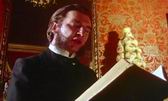
This is an examination of pornography and sexual mores since the times of Queen Victoria, when the guardians of public morality were far more hypocritical than they are now, in the seventies. Or are they? Take the plight of average British male Horace (Chris Lethbridge-Baker), who is delighted at the new loosening of restrictions on pornography, but cannot translate this into his home life when his wife is so opposed to sex. Horace is reduced to traipsing round the sex shops of London, occasionally being tempted by the odd, decidedly tame blue movie...
Much like the audience for Naughty! would have been back in 1971, for this was smut expert Stanley A. Long's pseudo-documentary on the subject closest to his heart, that of how much flesh he could get away with showing under the pretence of being a serious investigation. Alarm bells should be ringing when the dramatic reconstructions far outweigh the footage of interviewees, although those actual people, as opposed to the actors, are far more hair-raising even today than anything Long and his co-scripter Suzanne Mercer can come up with.
Those reconstructions, usually of the Victorian era, are played for "can you believe things used to be like this?" laughs, with the father shown to be operating under double standards where he will lecture his teenage son on the evils of masturbation while secretly attending prostitutes and buying explicit postcards unbeknownst to his family. None of this is particularly hilarious, yet brings out the weird tone which is all for sexual liberation, but cannot disguise a nervous bead of sweat on its brow as if worried that someone will confront the filmmakers on the validity (or otherwise) of their work.
There's a definite air of desperately trying to make us accept this sleaze as perfectly natural, though it was a far cry from the Britain it hoped to portray and the more furtive where sex was concerned unless it was all for a laugh Britain that existed in reality. Nowhere is this more obvious when the filmmakers visit a porno film festival in the Netherlands and as well as showing us brief clips of the highlights, mostly a cartoon spoof of Snow White and the Seven Dwarfs, it interviews a few of the patrons, including the inevitable Al Goldstein who tells us that he is fully behind these productions and considers them far healthier than any war.
A rather extreme analogy, but one which is returned to a couple of times with other interviewees in "who is the real sick man?" heavy handedness. The most depressing parts are those which have not been staged, such as one part near the end where a middle aged man laments that his wife, sitting beside him at the time, refuses to be spanked by him and that their excursions into swinging had them encounter one man who was "literally" an "animal". But then there's John Lindsay, the outspoken Scottish pornographer, who also expounds the war is worse than what he does philosophy although one of his cast, when quizzed, seems incredibly dejected that this is the only steady work she can get. At this remove Naughty! looks to have been better titled Grotty! and is mainly telling for its own attitudes rather than any censor's.
Long got his start taking nude photos, branched out into short films, then embarked on a series of features which lasted a good three decades before he moved into a post-production capacity on many titles up until just before his death. It was those sexploitation flicks which made him a millionaire, capturing the public's interest in increasingly racy subject matter, making his career a textbook example of loosening censorship, from nudist colony movies (Take Off Your Clothes and Live) to mondo documentaries (West End Jungle, Primitive London, London in the Raw), to full on softcore such as Groupie Girl, The Wife Swappers, Naughty, On the Game, his highly lucrative Confessions of rip-offs The Adventures of... series, and his finest film Eskimo Nell, rightly cited as the best, or at least the funniest, of the whole genre. He also penned a revealing autobiography.