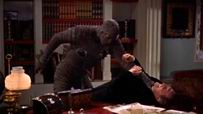
The year is 1895 and a small British expedition to Egypt has uncovered a hitherto undiscovered tomb which they have just opened. Leading the survey is Stephen Banning (Felix Aylmer), whose best friend Joseph Whemple (Raymond Huntley) is also present at the dig. Banning's son John (Peter Cushing) has been incapacitated with a broken leg, and Joseph is keen for him to return to a hospital so that it can be set properly, but John is reluctant to leave the site lest he miss something important, risking a permament limp. Yet there are to be more dangerous complications than that when Stephen enters the tomb and encounters... the undead...
After Hammer had had success with revamping Dracula and resurrecting Frankenstein, the most natural project to tackle next was a remake of Universal's Mummy movies, and thanks to a deal with the American studio that's precisely what they did. Scripted by Jimmy Sangster, it stuck closely to the traditions set out by the nineteen-forties series, with Christopher Lee, the man Hammer was going to to play their monsters, an imposing villain enveloped in his bandages and doing the bidding of Mehemet Bey (George Pastell), the erudite but dastardly Egyptian who was carrying on the traditions of his ancient forebears.
Politically, this was an interesting project for the time as the Suez Crisis had ended just three short years before and the United Kingdom was seeing its colonial power drastically reduced. Hence there's a sense of the British having revenge inflicted upon them by one of the countries they had attempted to control in this version of the tale, with their depiction as having little respect for the foreign lands they ended up in. Here, although they are the heroes, and rarely was there a more upstanding British hero than Peter Cushing in his Hammer movies, there is a strong strain of guilt and subsequent punishment running through the mishaps that are exacted upon the protagonists.
At its heart, however, The Mummy was content to play out the scares, and with Terence Fisher directing, the audience were in safe hands. Neverthelesss, there was an amount of padding to be endured here, with a flashback to Kharis the Mummy's previous existence as a High Priest who went against the Gods by trying to bring his beloved Priestess back to life. This doesn't add much when you want to get back to the suspense, and largely seems to be included to give Lee something else to do in the film other than be covered in makeup and chase around after the cast. And then it's followed by another flashback to Stephen's madness-inducing meeting with the monster, telling us something we already knew.
Not that this Kharis isn't one of the best examples of the subgenre, as where Lon Chaney Jr would spend an inordinate amount of time shuffling after his victims - yet still caught up with them - here Lee positively races after the unfortunates that Mehemet has sent him to kill, a powerful and well-nigh unstoppable force. John, by contrast, has that lame leg, and it is he who does the limping, a clever turnabout by Sangster which adds to the tension. He is only saved when his wife Isobel (Yvonne Furneaux) interrupts Kharis in his strangling activities by closely resembling the Priestess he vowed to protect; whether she's an authentic reincarnation is left open for the audience to make up their owns minds about. This remake is on a par with The Mummy's Hand, not an all-time classic, but better than many in its style thanks to a solid villain. Music by Franz Reisenstein.
[There are now Blu-ray and DVD double disc sets of The Mummy, as part of the Hammer collection brought to HD. Other extras include Fisher's Stolen Face included as a bonus film, many documentaries on the film and studio and an expert audio commentary.]