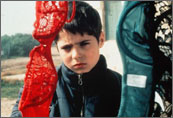
For a movie with such a blatant mammary fixation, Bigas Luna’s fable surprisingly isn’t crass but charming. It’s the Catalonian director’s most engaging film, drawing upon his own childhood and personal symbolism. Little Tete (Biel Durán) is annoyed since a new baby brother means he can no longer suckle at his mother’s breast. He fixates upon amble-bosomed, new arrival Estrellita (Mathilda May), a ballet dancer with the travelling circus, and fantasises about her breasts squirting milk straight into his mouth. Tete’s pre-adolescent yearning for Estrellita is hindered by her marriage to Maurice (Gérard Damon), “the Flame King” with legendary farting prowess. Worse, Tete’s friend Miguel (Miguel Poveda) falls madly in love with her too.
A gentle, dreamlike story, beautifully shot in soft pink, blue and golden hues, the film tackles the delicate subject of a child’s burgeoning curiosity about sex. Its rambling, episodic narrative befits the daydreaming hero, with frequent bursts of playful fantasy: Tete imagining himself an astronaut, his dad as a Roman centurion, and women gleefully offering their breasts. The subject matter might trouble some, but Luna and his characters display tolerance and understanding. Luna continues his satirical swipes at Latin machismo. Indeed this is his most wide reaching satire of Catalonian culture. “Show some balls”, is Tete’s father’s constant refrain. The emphasis small town traditions place on masculinity is slyly sent up. For Luna overtly macho behaviour masks men’s powerlessness before feminine sexuality, driving their neurotic need to posses women utterly. Poor, lovelorn Miguel is a playful send-up of the Latin lover. He woos Estrellita with traditional love songs, competing with Maurice blasting records of Edith Piaf. A hilarious scene that becomes rather moving because Miguel Poveda (an accomplished singer) performs so sincerely.
Thankfully, Luna doesn’t reduce Estrellita to a pair of breasts. Though beloved by bad movie aficionados for her naked space vampire in Tobe Hooper’s Lifeforce (1985), this is Mathilda May’s finest performance. She touches each male character in different ways, captivating as lover, surrogate mother and spouse. Her ballet sequences (May is a classically trained dancer in real life), set to Nicola Piovani’s lovely score are magical highlights. Quirky in her own right, Estrellita is turned on by Maurice’s spectacular farts and collects men’s tears. Like Luis Buñuel, Luna accepts weird kinks as part of human nature. There is a touch of Federico Fellini about the provincial setting, cartoon characters and fantastical flourishes, but touching performances (including future director Laura Maña as Tete’s mother) and generosity of spirit prevent them becoming simple grotesques.
The moon represents desire, love’s young dream, something to reach for, to spur you on towards maturity. In the end it’s love, pure and simple, that everyone yearns for and each character finds some aspect of it by the fadeout. It says something about Luna’s humanity and makes this strange, funny, enlightening fable a wholly beguiling experience.