There are a lot of wealthy households around this area of the Spanish countryside, but that can be perilous as well as idyllic. Take this lady who wakes in her bed and thinks she hears someone downstairs, so gets dressed and investigates, only to find Charlie Chaplin hamming it up in her living room. She is unfazed and starts telling him that their relationship is pretty much over, so she will be throwing him out no matter what he gets up to in order to amuse her, but as she reaches for a letter, against his famed screen persona, Charlie grabs the nearest scissors and stabs her straight through the hand.
Then her screams can be heard from outside the house as he slaughters her, or they would be if there was anyone to hear them. That's right: there's a killer about. A curious way to start off a giallo, and the thoughts of the estate of Sir Charles Chaplin were not registered, in fact that opening sequence was so bizarre and inappropriate that the rest of the film had a hard time living up to it. We're talking a movie that lasted almost two full hours, which many fans may have judged ill-advised for this genre to go to that over-generous length, and when you realised they were going to fill up the time by dawdling for much of it, you might have thought it was not worth your attention.
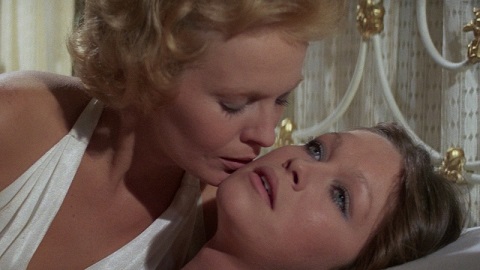
However, as those who have taken a chance on it have discovered, director Juan Antonio Bardem (uncle of movie star Javier Bardem) was no slouch in constructing a strong setpiece if need be, and he was evidently enthused by transgressive material. Not merely the thumbing of the nose at classic Hollywood that kicked things off, but the business at the house down the road where Ruth Miller (Jean Seberg, who did this strictly for the cash) and her stepdaughter Chris (Spanish celebrity Marisol) are staying and suffering a relationship fraught with unbalance. Chris, because she has suffered a trauma in her past when at school in the changing room showers, so is now panicked by falling rain, and Ruth because her husband "disappeared", leaving her this house but no friends.
Therefore she has developed an erotic fixation on Chris and is keen to ensure she must depend on her stepmother. But what would one of these melodramas be without a third party? Step forward Barry Evans-a-like Barry Stokes as an English drifter who rocks up at the mansion and inveigles his way into the women's lives. This was, effectively, a mystery plot, though the actual mystery was less compelling than watching these weirdos firing off at one another. We are supposed to believe Stokes' Barney character is really the murderer who has been running rings around the police, and there was a genuinely unpleasant sequence where the culprit arrives at yet another rich country manor and proceeds to slice up the whole family, including children, with a sickle.
Though the dog escapes the massacre for reasons that are explained in a throwaway line near the end. Naturally, this sort of edgy material was troublesome for the censors in then-fascist Spain, but Bardem had a habit of pushing the boundaries and making life difficult for himself, all to score points against the dictatorship he despised. That is why there are two endings for the film, one where characters get away with their crimes, and another where they are found out, thanks to a twist that is frankly rather farcical, but you cannot say it was not original. With some well framed Panavision photography and a better than it needed to be soundtrack by Waldo de los Rios, even Seberg appeared to understand this was worth giving a proper performance in, no matter her distaste. It's strong stuff in places, but not bad at all and able to stand tall with some of the better examples from Italy, land of the original giallos.