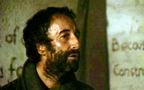
It is D-Day 1944 in France and a group of prisoners of war held by the Nazis are forced into working for their captors. What they are doing is digging trenches by the coastline for defence purposes, but this day the Allies attack, raining bombs down on both soldiers and prisoners. Running for cover, a group charge into the entrance of a blockhouse, but it doesn't seem safe. One man suggests that they hide deeper into the bunker, and as they do a bomb crashes overhead, sealing the entrance. Now there is nowhere to go but down, and the seven men climb down a shaft in the darkness lit only by torches. Little do they know just how long they will be staying there...
One of the most unrelentingly grim films ever made, The Blockhouse was scripted by its director Clive Rees and John Gould from the book by Jean Paul Clebert. The captions at the beginning tell us that this is a true story, and that out of the seven, only two men survive, but what they don't tell you is that this will be an exercise in suffocating claustrophobia - if getting trapped in enclosed spaces disturbs you, you may want to give this one a miss. Despite the appearance of Peter Sellers in the cast, this is not a star vehicle and certainly not a comedy, it's more of an ensemble piece with each actor getting their unenviable chance to be beaten down by circumstances.
After the opening sequence, we never see daylight again, as is true for five of the prisoners, having swapped one jail for another, only one in which there is little hope of escape. At first they are delighted to have got away from the bombardment and into safety, especially when they see what the Nazis have stored down there. There is an extensive wine cellar plus a selection of cheeses and tinned food, and also boxes of candles to light the ominously silent rooms: surely enough to keep them happy until they are saved? They light many of the candles and tuck into the food and wine, not realising how long they'll be stuck there.
And in fact, they begin to lose track of time having no way of knowing if it's day or night and no way to judge the calendar. The man who was their leader above ground, Aufret (Peter Vaughan), tries to assert his authority but it's to no avail and soon tempers are frayed and scuffles break out, leading Aufret to isolate himself from the others. Meanwhile they try to stave off the boredom by playing games: Visconti (Charles Aznavour) has a pack of cards and Grabinski (Jeremy Kemp) fashions a chess board and pieces out of carved candles. But the oppressive nature of their predicament can't help but dampen their spirits.
Particularly as there appears to be no hope of rescue. The gloomy lighting and mumbled dialogue just underline the hugely depressing nature of the story, and when the men start to die off it's not exactly a laugh riot. First to go is Aufret, who commits suicide by slashing his wrists, but as the time drags on most of them succumb to depression and ill health. Sellers manages a kind of pained nobility in his performance, as they all grow to accept they will never be freed but self pity never really dominates. By the end of the film, the candles are running out and the hollow-eyed survivors have to come to terms with living the rest of their time in darkness. The film never shows us a rescue party, either, it cuts off with years of their endurance to go, leaving not a celebration of the human spirit but a example of the battering it takes. Music, what there is of it, is by Stanley Myers.