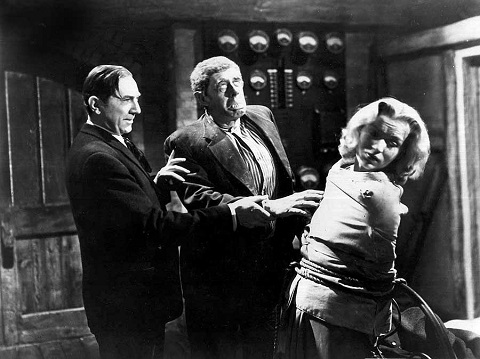
A dead body has been found washed up on the mud flats of the Thames River, and the police are called to help identify it. Detective Inspector Holt (Hugh Williams) is assigned to the matter, apparently because his boss has no faith in him so doesn't expect much from what appears to be the death of a vagrant, but Holt thinks there is something suspicious going on when the dead man proves to have had a life insurance policy that was owed to the charitable businessman Dr Feodor Orloff (Bela Lugosi). He seems to have his heart in the right place - but another drowned body recently had a policy in Orloff's name, so what is going on?
The Dark Eyes of London, if it is remembered by film buffs at all, was famous for being the first film the British censors branded with the H certificate, the H standing for "Horrific". This was both a way of keeping the children out of cinemas showing such movies, and to stigmatise such entertainments, though as they found with the later X certificate, it generated far more interest from the public in such efforts than if it had simply been awarded an A certificate for adult audiences. The British do love their moral panics, as the Video Nasties era had demonstrated, but before VHS was even thought of, there was the thirties horror boom to disdain.
Mostly brought about by Universal Studios and their blockbusters like Dracula and Frankenstein, this craze for fright flicks was big business across the Pond, and in Britain there were attempts to cash in, but it was not to last as the moral guardians saw to it that horror movies were shut down. It now seems incredible that one, albeit major, market could force a Hollywood studio to cease production on their most lucrative franchises, yet this is what happened, and for a few years in the mid-thirties there were no chillers produced at all. However, public interest in them never waned, and a rerelease of the Boris Karloff and Lugosi pictures proved there was a demand for them.
Keen to get in on the act, British producers snapped up horror talent for their own works, and The Dark Eyes of London was Lugosi's main contribution, a juicy role of the sort he was not really getting in Hollywood. He would doubtless have made more, only the Second World War broke out, and made travelling a lot more perilous, which meant more Poverty Row B-movies for poor old Bela, but at least he could point to this and say, yes, I can deliver a proper performance in a well-mounted film and, though he was far from appearing in every scene, he could legitimately been observed to carry it and be responsible for its success. Supporting him was a motley crew of leads and character actors, with the Brylcreemed Williams the ideal inspector for this Edgar Wallace adaptation.
Joining them as the leading lady was Norwegian sensation Greta Gynt (though she had lived in Britain since she was small), adding a touch of visual appeal to what was otherwise very dour and creepy. We were asked to find a home for the blind as the most unnerving place possible, which the film finally relents and admits these sightless men are merely unfortunate and not the real villains, though one of them actually is, the hulking brute Jake (Wilfred Walter) who does the dastardly doctor's dirty work for him. Also here was Edmon Ryan, an American import to connect with the American market and to add comic relief as a Chicago cop who is there in London because... well, good question. Just to ensure things don't get too morbid, perhaps. Seen for decades in poor public domain dupes, the film was eventually restored and highlighted a very enjoyable, shivery horror yarn that saw its profile rise above its previous dismissal, and can be recommended on that level. Jess Franco, anyway, must have liked it. Music by Guy Jones.
[The Dark Eyes of London is on Blu-ray and DVD 11 October 2021 from Network.]