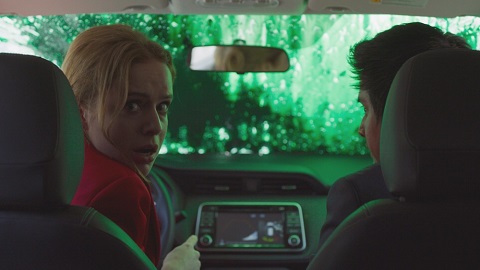
Marianne (Naian Gonzalez Norvind) is one of Mexico's elite class, a privileged white minority who believe they rule the nation. But how true is that? There have been rumblings of unrest across the country and now, in Mexico City where a celebration is being held by her family it seems the unrest has reached their front door. Green paint appears to be the signature of the would-be revolutionaries, as it is splashed around as close as the underclass can get to the upper class, but what if they upped their game? What if they stopped using the paint and started using bullets? And who is really behind this divided society?
New Order, or Nuevo orden if you were Mexican, was an extremely controversial film if indeed you really were Mexican, yet in the time of the pandemic gripping that society, it proved a substantial hit when it turned into the must-see movie of the year. Writer and director Michel Franco, himself identified as one of the white elite and therefore due some suspicious side-eye from many in light of his apparent political message here, was, he said, positing the community he belonged to as being manipulated by a sinister military authority as much as anyone in the non-white population, and that was his overall point.
Not that the more fervent critics of the film saw it that way, they took one look at the dark-skinned, gun-wielding terrorists depicted here and the largely pale-skinned victims and told Franco, and indeed anyone who would listen, that he was being racist, pure and simple. Imagine if Hollywood made a movie where the African American populace took up arms against the whites and started a race war? That was, to some eyes, what Franco was recklessly creating here, though they appeared to have missed the pointed final scenes where it was apparent those in charge were not the so-called "ethnic" citizens those critics could not see past.
But even so, despite the director's protests that he was making a story about how fascism could so easily assert itself in an increasingly right-wing world, nobody was forcing his fictional dark-skinned rebels to murder the white-skinned privileged, and it was perhaps a real leap to go from maid or manservant to willing ally of the violent uprising as after all, most people do not have that propensity for brutality in them, or at least it has to be forced out of them rather than coaxed out with a promise of a reward. Were most places more stable than Franco supposed? It is a tempting fantasy to believe that society is on the brink of breaking down, but are there not enough positive individuals who are unwilling to allow the situation to get that bad? Does not everyone wish for a peaceful order?
Well, said this movie, you're not going to get it without a lot of bullet-riddled corpses first. It's difficult to argue with that utterly unsentimental cynicism, especially as it is so convincing to those who live it, and to be fair Mexico in the twenty-first century came across as a state that was collapsing under the weight of the corruption in the authorities and the drug cartels trying to run the country on the other side, not that they were not interlinked. Therefore, given you are a product of your background, it was little wonder that Franco would present a worst case scenario, even if not all of his countrymen and women would agree with him. If you were looking for cinematic violence, then there were certainly examples in this, but it was the violence of the cultural climate that would see citizens pitted against one another who in another set of circumstances could have been working together successfully. Is it easier to curse the darkness and not light the candle? This could have you believing that. It had power, but also monotony.