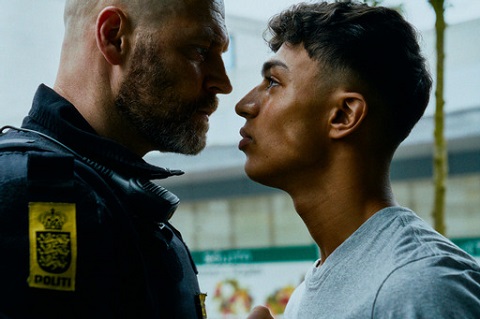
Jens Hoyer (Simon Sears) is a cop in Denmark in an inner city where there have been racial tensions rising ever since a young Arab man was arrested and hospitalised after being held in police custody. He is now seriously ill, and the young men of the area are itching for a fight, something the cops are all too aware of, Jens especially since he feels he could have done more to prevent the impending doom on the ground, having been in the room at the time of the attack. His fellow officers know this too, and this is making him unpopular, which may be why he is paired with the most obnoxious of his colleagues, Mike Andersen (Jacob Lohmann), who he must accompany on patrol, deep into the ghetto where danger awaits...
The best way to approach Shorta was as an action thriller first, and a tug on the social conscience second, that despite the obvious pleas to racial unity and understanding that writers and directors Frederik Louis Hviid and Anders Olholm included at regular intervals. Not that you could take or leave these parts, they were integral to the plot after all, but the film operated best as a thriller with more heft to its intellectual pretensions than you would find with your average straight to DVD or streaming action effort. In that respect, there was an appeal to the Black Lives Matter movement in its intent, to highlight policing problems with regard to race were not exclusive to the United States, but frankly the filmmakers appeared to be even more committed to tension and excitement.
Mike attempts to break the ice with Jens in their patrol car with a few off-colour jokes and confessions, yet reveals himself as a small-minded man who really needs to be taught a lesson. Said lessons arrive as the film enters its second half, as he and his reluctant partner (as far as we can tell, however Mike keeps his cards close to his chest) arrest a young Arab man (Tarek Zayat) but quickly find that trying to haul a prisoner around an estate that is literally turning into a warzone before their very eyes is inadvisable at best, downright suicidal at worst. This young man is actually one of the good guys and will provide an asset to both lawmen should they realise they can easily get along with him, but of course Mike is so prejudiced that it will take a crowbar to prise him away from his deeply held, yet knee-jerk beliefs. So be it, says the script, and sets about making a new man of him.
Some mentioned John Carpenter in connection to the style and material here, the cult American director still an influence on the younger generations of filmmakers emerging in the twenty-first century, and there was a sense this was a socially conscious combination of Assault on Precinct 13 and Escape from New York in a Danish ghetto. No bad thing, and Hviid and Olholm had learned their craft well if they had taken their cue from Carpenter, for there were sequences here that generated genuine tension even if you were not too keen on the characters, largely thanks to things getting so dire that night that you would prefer to see them get better rather than worse, or rather, not degenerate into further mayhem. You may not learn very much about racism that you were not able to work out for yourself, but there were interesting elements, such as the way it's just as likely to make whites violently fall out with other whites as they are with non-whites. But in the main it was guns pointing, running while injured, everything lit by unforgiving sodium yellow streetlights, masked Purge-style gangs, you know the drill. Music by Martin Dirkov.